It seemed like another typical Wednesday morning. After the car ride to school and the walk through the weapons detectors, I passed groups of students in the hallway; some stared blankly at their phones while others engaged in conversation. Normally, all the chatter blended together, but this time, the tone was different.
Instead of discussing the latest gossip, students focused on one main topic: the proposal for a new phone ban, which had just passed the Kentucky state house.
Word quickly spread around my school. Some students were concerned, others surprised and a handful were excited.
Everyone seemed to have their own idea about what it might entail, but in general, the consensus was that it was unrealistic for schools to ban phones.
Rumors soon spiraled into exaggerations and hyperboles, but nothing had changed — yet.
In each class, students continued to glance down at their phones, and teachers still issued reprimand after reprimand. Technology had become an integral part of nearly every classroom. Many assignments required laptops, and debates frequently arose between students and teachers regarding the use of artificial intelligence (AI) on assignments.
Then, on March 26, things moved from speculation to paperwork as Gov. Andy Beshear signed House Bill 208, a quick legislative turnaround for schools.
This decision marked a pivotal change in the lives of many Kentucky students: technology, like phones and now, AI, is no longer treated as an innovation to adapt to. It’s treated as a danger that students must be protected from. But if we no longer have access to this technology, we’ll never learn to use it responsibly in the future.
In its original form, the bill required local boards of education to adopt a policy prohibiting student use of both social media on school technology and personal telecommunications devices during all times of the day. However, the House accepted an amendment altering the timeframe to just instructional time, loosening the restrictions and leaving the more serious decisions up to individual districts and schools.
As I looked further into the legislation, my confusion grew — would this new bill really cause any meaningful change?
Its impacts varied across the state. Some schools already had harsh restrictions, while others chose a more lenient approach, allowing phones in cafeterias or hallways.
However, I, alongside students across the district, felt the impacts hit home when JCPS voted between three implementations of the bill. The district could either allow phones in hallways and lunchtimes, just during lunchtimes or not at all.
On May 13, the JCPS board voted 6-1 in favor of the third, announcing that it would ban all cellphone use at all times during the school day — including lunch and transitional periods.
What began as a loose enactment at the state level soon trickled down into increasingly stringent restrictions. Still, the underlying principle remained the same: telecommunication devices would no longer be seen in classrooms.
The controversy surrounding restrictions on technology reflects a larger conversation, one that, if left unchecked, may have harmful impacts on kids across the country. Kentucky and JCPS policies that prohibit the use of technology are depriving students of educational support and digital safety lessons.
Unplugged
When students returned in August, nothing seemed different aside from new backpacks and an absence of last year’s seniors. But once the bell rang, it was clear that something had changed. In classes, people were unusually attentive.
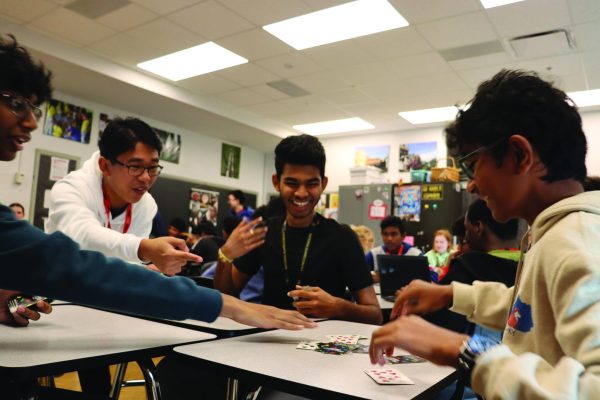
Instead of checking texts, students were listening to the teacher’s lesson. Rather than staring blankly down at their phone during lunch, they laughed and conversed with each other in the cafeteria.
At first glance, it appeared the policy was working. Its original purpose was to reduce distractions, increase in-class participation and enhance student well-being, and students began seeing these seemingly positive results firsthand.
Blue Snowden, 16, a junior at Atherton High School, noted that the phone ban has helped some of his friends stay persistent with their work.
“I have a friend who, a lot of the time, if she’s discouraged with her work, she’d want to give up,” Snowden said. “But I think not being able to just go to that safety net of going on your phone has encouraged her and a lot of other people to just keep working.”
I’ve also noticed this. For example, typically, when I didn’t understand a problem in math class, I would become overwhelmed and resort to distracting myself with my phone. Even when I chose to look up an explanation, having my phone on hand often lessened the impact of what I needed to learn.
Now, without these devices to depend on, I’m forced to keep working through the problem or ask for help from someone outside of the screen.
On top of this, the technology ban has successfully increased social connections. Students have seen this impact in just the first couple of months of school.
“Socializing has been kind of the biggest benefit so far,” Riess Starks, 17, a junior at Ballard High School, said. “I noticed a lot more people starting conversations and talking a lot more, when, last year, I feel like you could just be on your phone at lunch and avoid talking to people.”
Along with the anticipated effects of increasing in-person communication and class attentiveness, the phone ban has also had positive yet unintended results.
One example is the skyrocketing library checkouts across JCPS. In both middle and high schools, library checkouts within the month of August reached the thousands — up by hundreds from the previous school year. JCPS communications stated that, in the first 17 days at Pleasure Ridge Park High School, students borrowed 1,200 books, which is almost half the total number checked out last year.
However, Kentucky isn’t alone in its new phone policies. On a national scale, technology bans are becoming more prevalent. ABC News found that 20 states, including Washington D.C. and the Virgin Islands, have statewide bans, and another 16, including Puerto Rico, encourage technology policy changes at the district level.
From the perspectives of teachers and faculty, banning phones makes sense. According to a 2024 study by the Pew Research Center, 72% of U.S. high school teachers agree that cell phones are a major problem in the classroom.
Daniel Zakem, an English teacher at duPont Manual High School, experienced phones becoming an increasing problem after the pandemic.
“I would say that, since COVID, young people have had an even more difficult time than normal, feeling and being bored, and I think that the phones are kind of the, for lack of a better term, kind of the pacifier for that,” Zakem said. “It had become one of the biggest problems facing current high schoolers and college kids.”
He said he believes that the ban encourages students to pay more attention and said test scores in his classes have increased from previous years.
But limiting phones entirely also restricts their benefits; when students are unable to access a laptop due to a lack of resources or internet issues, their phones often serve as an alternative.
“The problem is that the phones, beyond having tools, also have attractions, things that tempt people,” Zakem said. “And so those temptations are gone — so too are the tools.”
And while banning phones during instruction may have benefits, restricting them at all times reduces students’ autonomy and ability to learn self-regulation in the future.
“The phone ban’s done what it’s supposed to do, but I don’t know, it felt kind of harsh,” Starks said.
When JCPS chose to implement the strictest proposed policy, they sent the message to students that they do not trust them to use their phones responsibly, even outside of the classroom.
“It’s definitely helped me and other people I know focus better in class, but I still don’t really understand the point of banning it during lunch and passing periods,” Lola Myers, 15, a sophomore at Atherton, said.
Walking into school in the morning, students want to feel welcomed and supported, not like they’re being monitored and controlled from the moment they step through the door.
Students need to practice technological responsibility now, before entering their adult life, when they will have these devices without supervision.
“Phones are a tool,” Snowden said. “I think that if there was a way to have students learn to use them effectively, that could be more beneficial than just banning them entirely.”
Alternative Intelligence
This new reality of technology bans also collided with another rapidly expanding platform, one that has become a heated topic in the classroom: AI.
The conversation regarding its usage in schools is highly debated, as, like phones, it can be both a tool and a hindrance.
For one, AI can help synthesize information that would otherwise be difficult to understand.
“I think it can help you more than other resources can. If it’s a specific problem, there’s not a YouTube video for everything,” Starks said. “It takes a long time to find specifically what you’re trying to figure out, and it’s really good at answering that.”
Personally, I’ve used AI to make study guides and explain information to me that I couldn’t previously understand. It can easily generate information and focus on specific topics, enabling students to create specific review materials. All of these functions prove to be particularly useful, especially for those who need further practice.
Sharvil Saxena, 17, a senior at Manual and the president of the Manual AI club, agrees.
“When you need to study for those exams, you’re able to upload the course material and really gather and create your own personalized study plan,” Saxena said.
However, with the new phone ban, the use of this technology becomes extremely limited.
Though phones are a distinctly different form of technology, district policies have begun to treat them similarly, sending the message that all technology, no matter how beneficial it may be, should be kept out of students’ hands.
On JCPS devices, GoGuardian, a software that restricts websites and allows teachers to monitor student activity, blocks many sites classified as AI.
I’ve experienced this personally. Teachers sometimes ask us to use AI software for in-class assignments, such as data collection or interactive lessons. But when we attempt to access it, a lock appears on the screen.
Generative AI platforms aren’t the only ones that are blocked. Other commonly used tools, like grammar and plagiarism checker sites such as Quillbot, may be restricted if they use AI for these tasks.
These restrictions aren’t for no reason, however.
One of the most significant problems with youth using AI is the safety risks it poses. According to IBM, AI usage can result in unconsented data collection, among other consequences.
William Pierce, the JCPS executive administrator of Educational Technology and Media Services, agreed that compromised safety is a major concern with the widespread implementation of AI in JCPS. He noted that, to train AI models, companies often use personal data, which may have negative consequences for users in the future.
Another potential disadvantage of AI is that it can lead to academic dishonesty when used as a shortcut instead of a resource.
Myers has noticed that, most of the time, when she sees students using AI, they’re using it for plagiarism, not to advance their comprehension.
“I rarely ever see students using it to help them learn,” Myers said. “Occasionally it’s used to help further understanding of topics, but that’s about it.”
According to another 2024 Pew study, 26% of teens report using ChatGPT for their schoolwork — double the amount from 2023. Both students and teachers believe that this detracts from the learning experience.
“I think part of learning and getting assignments done is trying to figure it out on your own,” Starks said. “Assignments are there to help you learn, and when you’re not just doing it, you’re not getting anything out of that.”
Whitney Marples, an English teacher at Southern High School, agrees. When students don’t complete their own work, it defeats the purpose of the assignment.
“You’re not getting what you need because you’re not doing what the assignment is needing you to do, which is learning,” Marples said. “We’re not just asking you for correct answers; we’re asking you to go through the process and learn it.”
Level Up
Taken at face value, this restriction may not seem significant, but upon closer examination of statewide policies, I began to see an ideological disconnect.
The JCPS approach that mine and schools across the district follow conflicts with guidance from the Kentucky Department of Education (KDE). KDE wrote in a 2025 statement that AI will have profound positive impacts on education, and that school leaders and staff should all familiarize themselves with responsible uses of AI.
“We need to constantly adapt as AI continues to evolve at a rapid pace each day, month, and year,” KDE said in a statement on Dec. 17.
Though the blocking of these technologies solves their negative impacts in the short term, students have access to them outside of school and will continue to long after they graduate. By removing these resources entirely, students can’t be expected to safely and responsibly use them, especially as they enter the real world and a workforce evolving to AI and increased technology.
According to Pierce, however, JCPS is working to bridge this gap.
“When a student exits Jefferson County Public Schools, we want them to be understanding of the most relevant softwares, applications, everything else to really succeed,” Pierce said. “Generative AI is one of those things that, as I said, is not going away, so we want our students to leave prepared.”
Pierce stated that these changes will be incorporated in the coming months.
“We will be rolling out generative AI access for students,” Pierce said. “We’re highly encouraging schools to participate in those so their students can understand these things.”
But many teachers and students want JCPS to take this rollout a step further by incorporating AI education into school curriculums.
Marples uses AI to assist her with repetitive and time-consuming tasks like grading and believes that it’s helpful if teachers show students how to use AI to further their learning.
“It’s the same as giving anyone a tool you don’t know how to use,” Marples said. “They could do beautiful things with AI, but if we don’t teach them how to use it, then they’re just going to end up turning in a bunch of trash papers and not learning how to write.”
Students like Myers and Saxena agree.
“It’s kind of beneficial when a teacher talks about it because they can educate students on how to use it wisely and better,” Myers said. “It teaches students that they can use it for more than just copying and pasting something and that they can actually use it to educate themselves.”
Saxena believes this begins with JCPS.
“Schools and institutions should really be just focusing on showing — establishing — baseline critical thinking problem-solving skills,” Saxena said. “So that when students go out and venture into the world, they’re able to leverage things like AI to their benefit.”
…
The pattern of differing messages at the state and local level can create confusing narratives for students and teachers to follow, especially when the policies themselves aren’t black and white.
Phones can be distractions, and AI can be used irresponsibly, but all technology teaches students valuable lessons they will need for the rest of their lives.
Handling technology in this age requires nuance — a level that blanket bans lack. JCPS claims it wants its students to develop into responsible citizens, but we won’t ever achieve this if we don’t have the tools we need to thrive in a digital age.