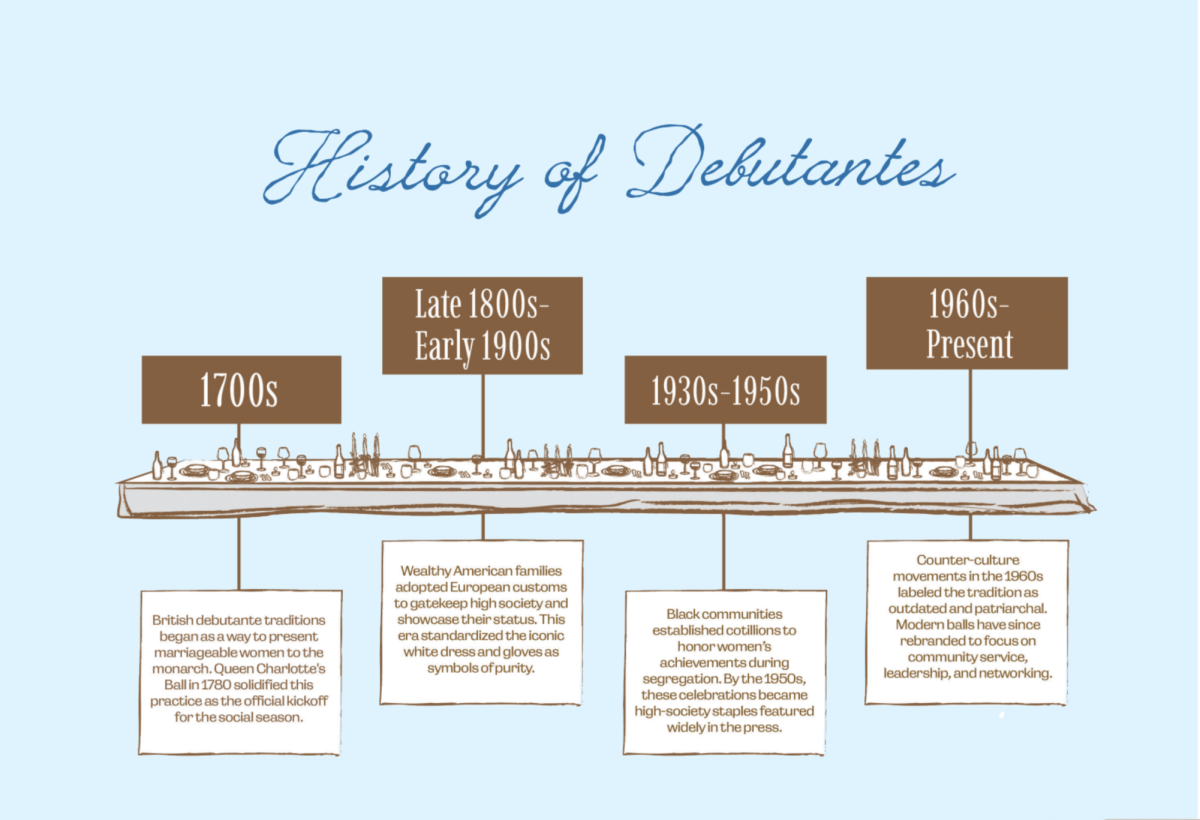
It’s the 1930s, and you’re sitting in front of a lit-up vanity, blending your foundation and patting blush on your cheeks. In order to accomplish your goal, you must look and act the part, and for what seems like your whole life, you’ve been preparing to do just that. You’re about to make a fashionable entrance into a glamorized “higher society,” just as your mother and her mother did before you. On this day, you are a debutante.
Historically, debutante balls served two main purposes: to find marriage opportunities for young women and to reinforce financial connections between families. Participating in this event heavily reflected your social standing, and the night functioned as a space where relationships, both friendly and strategic, could form.
As debutante balls found their place in American tradition, the culture offered women visibility in prominent social circles, and some gained so much popularity they became known as public figures. A select few even went as far as reaching celebrity status.
Iconic debutantes like Brenda Frazier and Barbara Hutton, both prominent in the early 20th century, showcased this enhanced visibility, sparking the term “celebutante.”
However, though the ballroom could launch women into the spotlight, the strict expectations forced them to embody ideals reflecting the misogynistic social norms of the time. They had to carefully curate their appearances, apparel and even voices to convey refinement and modesty.
The debutante ball served as the main stage for these expectations to be publicly displayed, working to reinforce traditional roles of women in marriage, even as national culture evolved. As organizations and movements of people began focusing on the personal endeavors or individual goals of women, the tradition slowly fell away.
In the past few decades, though, they’ve seen a resurgence — with a different look.
Modern Day
As the punk and grunge culture of the 1990s emerged, elitist critiques increased, and the relevance and importance of debutante balls plateaued. But, beginning in the early 2000s, the tradition returned. This time, however, emphasis on marriage and social standing dropped. Instead, the average debutante challenged old norms, with their programs focusing on enrichment opportunities for young women and men.
Organizations around the country started framing participation as a recognition of service, education and preparation for the future. The National Charity League (NCL), an organization dedicated to mother/daughter-based philanthropy, is home to the Los Angeles chapter, which hosts an annual debutante ball.
This modern debutante involves women in community service and emphasizes education; she’s not participating because her family needs an economic ally or because she needs to be wed — she’s taking part on her own terms. NCL Los Angeles is just one of many across the country. Organizations in hotspots like New York, Washington, DC., Texas, and California work to achieve similar goals, supported across the country by local chapters. In our very own city, a Jack and Jill of America’s Louisville chapter is doing the same.
Founded in 1938 by Marian Stubbs Thomas and a group of 20 other mothers, Jack and Jill of America is a national nonprofit organization aiming to improve the livelihoods of Black children. Their goal was to help their children receive social and cultural enrichment during the Great Depression. Though times have changed, they continue to fulfill their mission today.
Jack and Jill hosts 271 chapters nationwide, and each plans annual programming events related to cultural awareness, education, health, civic duties and recreational fields.
Louisville’s chapter is working to uphold these standards, but even as much recognition of debutante balls has shifted from whom a young woman might marry to what she can accomplish, historical stereotypes and contemporary misconceptions may keep people from getting involved.
For Mali Cochran, 17, a junior at Mercy Academy, once she overcame her original assumptions, experiencing the Louisville debutante ball pushed her to pursue her dreams and invest more time in the process.
“I thought it was going to be too much work,” Cochran said.
Her original reaction was based on the rigid example set by traditional debutante balls, but once Cochran joined Jack and Jill, she quickly learned that those expectations were incorrect.
The organization resonated with Cochran more as she participated, but it was more so her experiences with the beaux and debutantes that she views as the most valuable takeaway. She observed everyone’s approaches to growing up and moving on from high school and began looking inward.
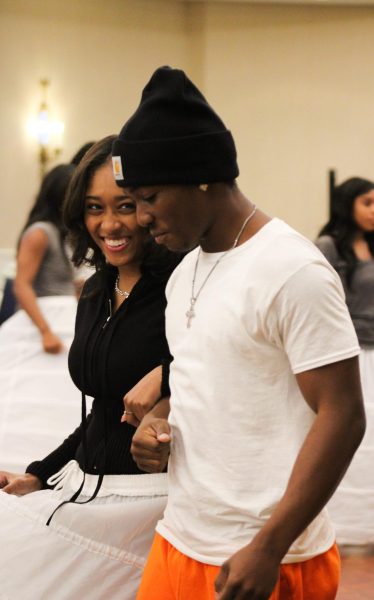
“Whenever I heard about other people’s goals in life, it kind of pushed me to go farther, too,” Cochran said. “Some people want to go to Harvard and some people want to play college sports, so it really made me think about what I want to do for me and my future.”
In the past, young debutantes could often feel trapped by the strict stereotypes of femininity, but organizations like Jack and Jill give young people the freedom to focus on whatever they choose, whether that be building connections, teamwork, school or personal growth.
Holden Beckett, 18, a senior at duPont Manual High School, is one of thousands of members at Jack and Jill of America and just completed his last year at the organization with the cotillion on March 21.
Beckett is a beau — the male escort to a debutante — who dances with and assists in their entrance to society. The beaux, the plural of a beau, and the debutantes gather frequently in order to foster deeper connections with their dates.
“We have about three months of team building and community service,” Beckett said. “It really prepares you for what comes next.”
Instead of functioning as a social and economic marketplace like past debutante balls, Jack and Jill focuses more on collaboration, confidence and personal growth.
Beckett described rehearsals as a space where debutantes and beaux encourage each other and create strong, lasting bonds.
“Everyone’s working together,” Beckett said. “If someone needs help, someone else steps in. It’s a really strong community.”
In contrast to the former debutante culture which only gave the white elite the opportunity to participate, Jack and Jill focuses on diversity and equality.
…
While many participants enjoy the glamour and visual appeal of the balls, many of their most treasured moments occurred outside of the public eye.
For Beckett, the most memorable experience was the mother-son dance.
“We do all these dances with our moms and then the daughters do all their dances with their dad,” Beckett said. “It’s a really wholesome moment to connect with your mom.”
Although debutante culture once centered around status, marriage and social expectations, modern organizations like Jack and Jill of America have transformed the tradition into one rooted in growth.
What was once a symbol of conformity and status has become a celebration of individuality, connection and the future that young people choose for themselves.