Pseudonyms are used for the names of some students in this article.
Once a year, eyes from around the world converge on Louisville.
Every spring, at the intersection of Fourth Street and Central Avenue, an eclectic arrangement of guests, from A-list actors and athletes to musical artists and political figures, gather to celebrate one event: the Kentucky Derby.
Yet, it’s not just the rich and famous who partake in this tradition of gambling on their favorite horses. Even for those without front row access, the culture prevails.
For as far back as I can remember, I have attended an annual Derby party with family or friends and typically made some sort of bet — often based on affection for a certain name, as was the case for my 2017 contender, Irish War Cry.
Locals of all ages congregate in garages, backyards and living rooms across the city to bear witness to the playing of “My Old Kentucky Home” and the draping of the Garland of Roses.
During Derby week, people throughout and beyond the city fixate on horse racing. Meanwhile, broader trends tell a very different story.
Largely absent from the Derby’s public narrative is that horse racing has seen a continuous decline throughout the United States. In 1989, an estimated 74,071 races took place. In 2025, the U.S. only hosted 29,401.
Now, for most Kentuckians who gamble, stakes are not isolated to those “most exciting two minutes in sports.”
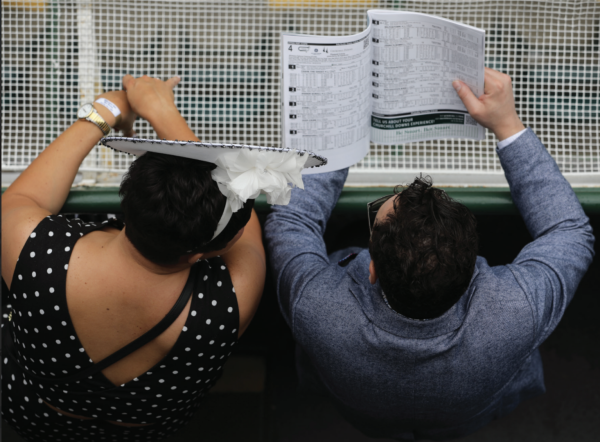
racing program on May 4, 2019 at Churchill Downs Racetrack. Photo courtesy of Churchill
Downs Inc.
The Supreme Court ruled in May 2018 that legalization of sports betting is a state-allocated power, knocking down a federal blanket ban on the sector. Since then, an increasing number of states have passed legislation signing this form of gambling into law as a form of tax-based revenue.
On March 31, 2023, Kentucky Governor Andy Beshear signed House Bill 551, legalizing sports wagering in Kentucky. This placed it alongside three other categories of legal gambling in the state: lotteries, charitable gambling and pari-mutuel, or pool-based betting.
In turn each of these designations have their own individual varieties. The latter includes live and simulcast wagers as well as Historical Racing Machines (HRMs) — electronic gambling terminals resembling slot machines that offer fixed-odd wagers on historical races.
The gambling industry has not always been this diverse.
For most of American history, gambling was heavily condemned — even George Washington denounced gambling as a villany.
Soon after the establishment of the U.S., a select number of states legalized lotteries. However, the vice didn’t truly gain traction until the Great Depression, when state legislatures began allowing horse race betting for the tax profit.
Thomas Lambert, an associate professor at the Department of Equine Administration and Economics at the University of Louisville acknowledges this.
“It was pretty much the only legitimate, legal form of gambling that most people could do in the United States unless they went to Las Vegas,” Lambert said.
Even in wake of the industry’s changes, the golden age of horse racing and what remains of its legacy parallel the landscape today.
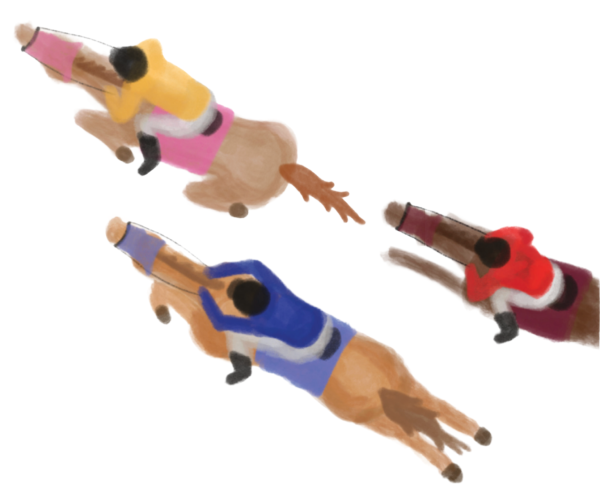
The Derby remains celebrated and, for most adolescents, still mirrors the seemingly harmless gateway into gambling.
Horse racing birthed this flaming industry, but that fire has come to engulf it, drawing in fresh fuel to bear the flame.
In late April, Kentucky Derby Festival Inc. hosts a number of local festivities from Thunder Over Louisville to the Pegasus Parade. Along with an assortment of others, the events that make up the Kentucky Derby Festival (KDF) inspire enthusiasm for “The Run for the Roses.”
Despite the attention towards the Derby, the parent company, Churchill Downs Incorporated (CDI), actually receives a diminutive percentage of its annual revenue from any of its in-person horse races.
CDI’s quarterly revenue statement for the end of the 2025 fiscal year disclosed the company’s total yearlong earnings at $2.93 billion. CDI attributed around 17% of this total to live and simulcast wagers across all of its horse races.
However, along with the rest of the gambling industry, CDI is moving away from its reliance on traditional time-restricted and in-person forms of gambling; the Derby only retains this funding due to its symbolic association with the company.
CDI designated the remaining nearly 83% of funds to its other gambling operations — a combination of casino gaming, online wagering services and HRMs.
Lambert explains that this gradual shift is, in part, a result of generational differences.
“I think one of the problems that it has with a younger audience is that, as time has gone by — and survey results show this — each generation is becoming less and less comfortable with seeing animals used to make money,” Lambert said.
He attributes this overall shift to economic dynamics. Adjusted for inflation, the gambling industry’s revenue has plateaued within the last 20 years, and researchers have noticed a substitution effect: the various modes of betting have been vying for slices in a relatively fixed pie. The gambling landscape is changing.
“These different forms of gambling, they have a tendency to cannibalize each other,” Lambert said. “Once a new form of gambling pops up that becomes legal or is extended into a new jurisdiction, it has a tendency to draw away from the other forms of gambling because there’s only so much money to go around at any given time.”
While Lambert doesn’t believe that the Derby is likely to disappear any time soon, the sport is losing traction, particularly among younger customers.
Under Kentucky law, gambling of any kind under the age of 18 is illegal — a necessary but somewhat ineffective barrier.
“Typically, people who gamble, it’s more skewed towards a younger age bracket from the very beginning — that’s whether it’s horse racing, casinos, playing cards, et cetera,” Lambert said.
In 2006, the Kentucky Incentives for Prevention (KIP) survey reported that 49.4% of high school seniors participated in gambling at least once in their lifetime. Yet, in a parallel 2024 study, this number has since fallen to 20.3%.
Evan Chisholm, 18, a senior at Louisville Collegiate School, occasionally participates in online sports betting. He didn’t begin gambling until his 18th birthday, but concedes that some of his friends did not wait.
“It’s risky to be 18, or even 17, if you bypass some verification,” Chisholm said. “If you’re underage and doing this, you’re not fully developed. So I don’t think you have the same willpower and control that some adults have.”
Evidence overwhelmingly explains that adolescents who gamble, especially males, are more prone than other groups to dependency issues later in life. This includes problem gambling (PG) but also encompasses other high- risk impulsive behaviors such as substance abuse and alcoholism.
Unfortunately, because the diagnosis for PG is based on patterns found in adults, there is ambiguity in its distinctiveness among adolescents. This may hinder the likelihood of identification by practitioners and youth themselves.
As with many behavioral addictions, PG is less recognizable on the surface. Unlike the bulk of substance abuse addictions, it has few visual or olfactory cues that signal a need for help.
Noah Hunt, 17, a junior at North Oldham High School, periodically spends time at Churchill Downs, where he will place casual bets.
“The moment you start chasing your losses, that’s when it starts to go downhill,” Hunt said.
Hunt and much of the literature agree that recouping, or regaining gambling losses, is often a sign of addiction.
Risk is intrinsic to gambling, more so than the industry would prefer anyone to see. Many problems emerge when one ignores that risk entirely, impacting personal finance and relationships.
It’s a gamble to stake your money in a flaming pit in the first place, but the consequences of jumping in after it are many degrees worse.
A 2025 study by Mariaelisa Renna et al. found that adolescents who gamble often show a distorted perception of risk, leading them to view gambling as a harmless activity.
Their underlying disposition is not the only factor that puts them in the line of fire, however.
Gambling, a profit-oriented industry, holds its assets in a vulnerable cash-based form. Balancing the industry’s own losses with those of its customer base is a tense corporate game of strategy. With too many wins, the game would cease to exist, but without a chance of winning, it would go unplayed.
Rather than allowing players to amass profits from the fire, the industry is designed to keep their hands in the flame.
High Risk, High Reward
In the English-speaking world, the words gambling and gaming have been intertwined for much of their history.
Historians trace the origin of gambling to just over 4,300 years ago. However, a discrete word for gambling didn’t emerge until the 18th century — derived from the term for a game.
But risk is what separates a game from a gamble; without the threat, gambling may appear to be an innocent endeavor. The gambling industry seeks to conjoin these once again.
All modes of gambling can be alluring, but adolescents are most vulnerable to those that stimulate intense gratification and require little effort.

Physical proximity is a central factor determining one’s willingness to place a bet. Some settings, like casinos or horse races, require travel, but online modes are only as far as one’s pocket.
“Some apps you need your social security number and something like that. The one I downloaded, you just needed a picture of your ID,” Chisholm said. “I was just able to upload money and then gamble, which I thought it was surprisingly easy to do.”
Yet, once in arm’s reach, fast- paced gambling doesn’t allow much time for consideration in between each bet, making it harder for an individual to decide to stop.
There is a huge difference, for instance, in the time from horse race to horse race and the time it takes to press a button on a betting app.
To uphold this cycle, payout rate (RTP) and payout can come into play. RTP describes the percentage of wagered money over time that bets are likely to return to a player. Likewise, payout is the amount of money any given bet returns. Higher amounts of both denote lower risk — or a better justification for the gamble.
There are two broad categories of betting, each of which capitalize on different aspects of the wagering process.
The first is parimutuel betting, which includes live and simulcast horse racing, and does not disclose a bettor’s chances until the betting pool closes. Instead, calculating the odds on a wager requires alternative preparation.
This extensive research is known as handicapping and is largely unique to parimutuel betting.
The second is fixed-odds gambling, which includes HRMs, lotteries and sportsbooks. These forms present players with RTP and payout before they place a bet and often display high probabilities of success.
Online sports betting, one form of fixed-odds gambling, is unique in that it does exhibit handicapping in its processes.
Still, while handicapping provides some friction, it does not directly reduce the risk of a gambling addiction. The perceived edge it offers can create the illusion of control over unpredictability.
“You can spend all week getting prepared for a day at the races,” Lambert said. “And guess what? Half of your efforts could go down the drain if something changes between the time you study the forms and the day you get to the track.”
Ethan Davis, 17, a junior, who is a friend of Hunt’s, agrees with Lambert.
“People look at stats and whatever there is out there, but you never know when something random will just happen,” Davis said.
That something can range from a horse dropping out of the race to rain on race day.
Different forms of gambling hide their risk in different ways. Some are more dangerous than others, but all have some level of uncertainty involved.
For Louisville teens who grow up surrounded by Derby festivities, it may seem like just another pastime.
“I think when I go to the track, it’s more of a ‘for fun’ thing,” Davis said. “Throw $5 on a race, just with our friends, just to have some excitement.”
Chisholm doesn’t believe he would have been as attracted to gambling had it not been prevalent in his friend group.
“It’s always another cool thing to talk about,” Chisholm said.
His preferred sports betting app even offers the incentive of sharing a referral code to receive a $5 reward.
“I think that spreads the idea that you should try to reach out to as many people as you can, and try to get as many people to go to that app,” Chisholm said.
Many youth who participate in gambling begin to do so as a social activity. The activity is most often spread through groups of friends where, incentivized or not, it tends to rise in popularity.
While much of adolescent gambling may remain purely social, many partakers are still unknowingly putting themselves at risk.
It is well established that the pain of a loss is significantly worse than a win of the same value. However, seeking help is just as, if not more, difficult when the threat of even greater loss is on the line — especially when success looks within reach. This is the paradox of this addiction.
McKay Coppins, a staff writer at The Atlantic, mentions misjudgment in the Supreme Court’s decision to relinquish the federal ban on sports wagering. He believes that the ruling came about for the sake of legality rather than ethics.
Containing a fire is difficult when people at all levels seemingly stand to gain from it. Gambling companies expand their revenue, state governments have their excise profit and people of all ages have their fun.
The same law that legalizes Kentucky’s sports betting industry also allocates 2.5% of the revenue toward the creation of a program for the education, prevention and treatment of PG.
The Kentucky Council on Problem Gambling is committed to carrying out educational endeavors with the new funding, helping change the general view of the vice.
A study from the Pew Research Center found that, between 2022 and 2025, the number of Americans aged 18 to 29 who viewed gambling as detrimental to society rose from 23% to 41%. Out of all groups surveyed, it was the youngest demographic and exhibited the highest percentage change.
However, altered views of gambling doesn’t necessarily equate to less of it. In fact, the Kentucky Problem Gambling Helpline reported more calls from 2023 to 2024, which may suggest an increase in the people who gamble, though current conclusions remain ambiguous.
All Bets Are Off
There is no date more common or popular for Louisville youth to participate in fueling the fire than on the first Saturday in May. In garages, backyards, living rooms, basements and Churchill Downs’ infield, people throughout Louisville gather to watch the city’s annual claim to fame.
Adolescents think they are playing a game, but in truth, they are playing with fire.
Though they’ve been cultured to accept the Derby as a harmless pastime, its implications go beyond entertainment.
…
There goes: a dollar here and a dollar there, for whatever the reason may be. It’s for one night. It’s for fun. It’s the Derby.
“And they’re off!”
Once the race begins, pairs of eyes follow horses, but in the minds of many, all they see are galloping bundles of cash.
The information in this article is provided for news and educational purposes only. Gambling involves financial risk. In Kentucky gambling is prohibited to those under the age of 18. Gambling content is intended only for legal-age adults. Participation in gambling can increase the risk of problem gambling later in life. If you, or someone you know has a gambling problem call 1-800-GAM- BLER or visit https://www.kygambling- help.org.