One by one, students at Eastern High School begin trickling out of the building, the dismissal bell still echoing in the background. Students haul instruments, backpacks and books along with them as they exit, and the trickle soon turns to a flood.
Though this is a common post-school scene, its normality masks an issue plaguing schools across the district — one that has existed since its creation.
…
By the 1960s, the baby boom prompted Jefferson County Public Schools (JCPS) to construct a majority of its current 169 schools.
Since then, the geographic distribution of Louisville’s population has changed, but the stigmas adopted by residents throughout the district haven’t.
Where families sought large clusters of schools half a century ago, enrollment is declining, and where student populations were once low, the district now sees larger numbers of students who need a seat.
“We have 117,000-ish seats, that’s student desks, in our school buildings, and we have 94,000 students,” JCPS Chief Operations Officer Robert Fulk said. “We have a lot of open seats. The problem, though, is they are not in the right place.”

For students at overcrowded schools, those open seats are nowhere to be found.
According to Fulk, it’s schools like Eastern High School and Atherton High School’s high transfer rates that keep their schools over capacity.
Matthew Key, a math teacher at Eastern High School, believes that overcrowding can negatively affect students’ experiences.
“Obviously, if you’re in a school that’s overcrowded, then it’s going to affect your class sizes,” Key said. “All the data shows us that learning is affected by class size. You all learn better when you’re in a smaller group.”
A 2024 study found that teachers are better at providing for individual student needs and that students have an overall more positive reception when their classes are smaller.
When students are in these environments, there are more opportunities for one-on-one help between them and their teacher, and behavior monitoring becomes much easier.
“But our numbers went up a little bit this year,” Key said. “What showed up in the fall was a little bit more than we had anticipated.”
Emmy Schindler, 16, a sophomore at Eastern High School, has seen firsthand the problems a larger class size can cause, and attributed some of Eastern’s enrollment numbers to the 2023 opening of Echo Trail Middle School.
“Since it’s a feeder school to Eastern, I’ve noticed that we have had a lot more people coming,” Schindler said. “I think it has burdened some teachers because the classes have been so much bigger.”
Over the past several years at Atherton High School, the student population has become so large that the campus can no longer support it.
In the 2025-26 school year, it was at 121% enrollment — well beyond the 115% the district deems as over-capacity.
William Tucker, a teacher at Atherton High School, has witnessed the effects and unintended impacts of this surplus.
“It’s hard to run a building and have day-to-day life going on when there’s that many people,” Tucker said. “You had lots of teachers that were sharing rooms. You had a number of teachers that were on carts all the time, having to move around the building from period to period.”
To remedy this, the district announced a $54 million expansion for Atherton’s building in February 2024.
This addition includes a new wing with more classroom space and renovations for the existing building’s utilities.
“I believe that next school year, everyone will have their own classroom space,” Tucker said.
This isn’t just a problem unique to high schools, though, as Echo Trail also faces large student populations because of its popularity.
With a current eighth grader and a rising sixth grader at Echo Trail, Matt Turner has seen the effects of a school with too many students and how a lack of transparency from the district can lead to parent outrage.
His daughter will begin attending Echo Trail in the fall of 2026, but recent changes to the school’s boundaries have altered the plans of her and her peers for the coming school year.
This issue is a result of Echo Trail exceeding JCPS’ optimal capacity limit.
“She’s losing a tight-knit group of her friends that were all planning to go to Echo Trail,” Turner said.
The expansion of southeast Louisville has had a significant influence on this increase in demand, with a $75 million housing development planned for June 2026.
The introduction of more homes within Echo Trail’s residential area, especially units considered high-end, has attracted more families to the residential area.
With more people aiming to live there but a static number of seats in the school, getting into Echo Trail has become competitive.
The 2025-26 school year was the first year that Echo Trail had all grades 6-8 in attendance, but JCPS has already had to seek solutions for over-enrollment.
The school was initially projected to be at 133% capacity next year. In order to prevent this, JCPS reconfigured school boundary lines, which shifted the expected enrollment to 117%.
To minimize the potential impacts on family plans, students already in attendance will not be forced to transfer.
As the classes residing in the old boundary graduate, the school’s enrollment will decrease from next year’s projected 117% to a more manageable number.
However, some families disagree with how JCPS handled the overcrowding situation.
Prior to the changes, some families moved to ensure they fell within Echo Trail’s boundary lines, but those seats are now no longer available to them. Instead, many are assigned to Crosby Middle School.
Plus, since JCPS proposed these changes one year before their estimated implementation, families have little time to adapt.
“Echo is a great school and it’s brand new. It’s got that curb appeal, but the programming is great, and so there’s a lot of good resources there,” Turner said. “I don’t blame people for being upset that maybe they have kids that aren’t able to go there anymore.”
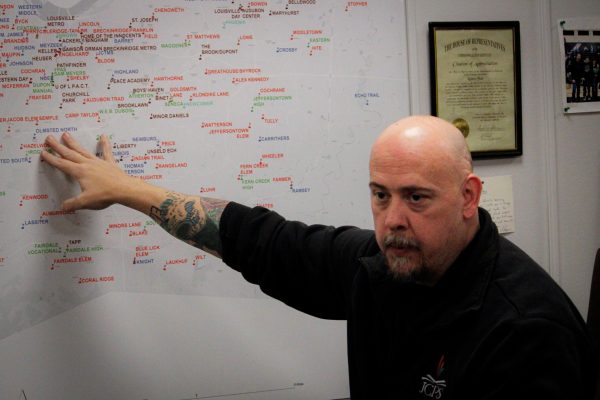
Jason Quinn, a former teacher at Crosby and current teacher at Echo Trail, said that, while the school has struggled with the influx of students, the school administration is mitigating the effects well.
“Things have to happen either from your administrator in your building or from the district to help remedy that,” Quinn said. “Despite the numbers here, we’re making it work.”
However, while some JCPS schools must learn to healthily manage overcrowded class sizes, others within the district struggle with the opposite.
This imbalance in student population has fluctuated for decades, but now, the contrast is stark.
As schools like Eastern, Atherton and Echo Trail adapt to meet increasing demands, there are 23,000 open seats across the rest of the district.
One factor that has led to declining enrollment in JCPS schools is the recent federal targeting of immigrants.
JCPS’s number of multilingual students rose to around 20,000 in 2024, which countered the district’s declining birth rate and put students in seats that would have otherwise gone empty.
Catering to more students means that JCPS gets the most out of their facilities.
Resources like classroom space, bus fuel and building utilities don’t go to waste when classes are of a healthy size.
However, recent developments in federal immigration policy under the current administration have impacted the district’s ability to maximize its student numbers.
According to Fulk, JCPS’s multilingual student population peaked in 2024, coinciding with the reelection of President Donald Trump, who has consistently advocated for mass deportations of immigrants in the U.S.
For many immigrant families, fear of deportation keeps them from sending their children to school.
“We’ve lost kids because they disappear or they don’t feel safe,” Fulk said. “And it all sucks, but that’s why we’re losing kids.”
With the combined factors of declining student populations and pressure to fix its $188 million deficit, JCPS released proposals last November to redistrict some schools and close or merge others in the coming 2026-27 school year.
The proposals announced JCPS’s intentions to close Zachary Taylor Elementary School and merge King and Maupin Elementries into Maupin’s existing building.
In January, JCPS approved the closure of both Zachary Taylor and King. Students from Zachary Taylor can attend one of the schools in the Ballard cluster or a magnet school next year. Current King students can now choose to attend Maupin, Kennedy, a magnet school or a farther away option.
JCPS references its 2025 Facility Profile Index (FPI) when explaining why it has decided to close specific schools.
The FPI uses three critical categories to find schools that don’t meet cost efficiency benchmarks, including facility condition, operating cost and enrollment trends.
In the FPI, Zachary Taylor is flagged in all three. Its cost per student sits $3,882 above the district average due to its diminutive student population — less than 75% of optimal capacity.
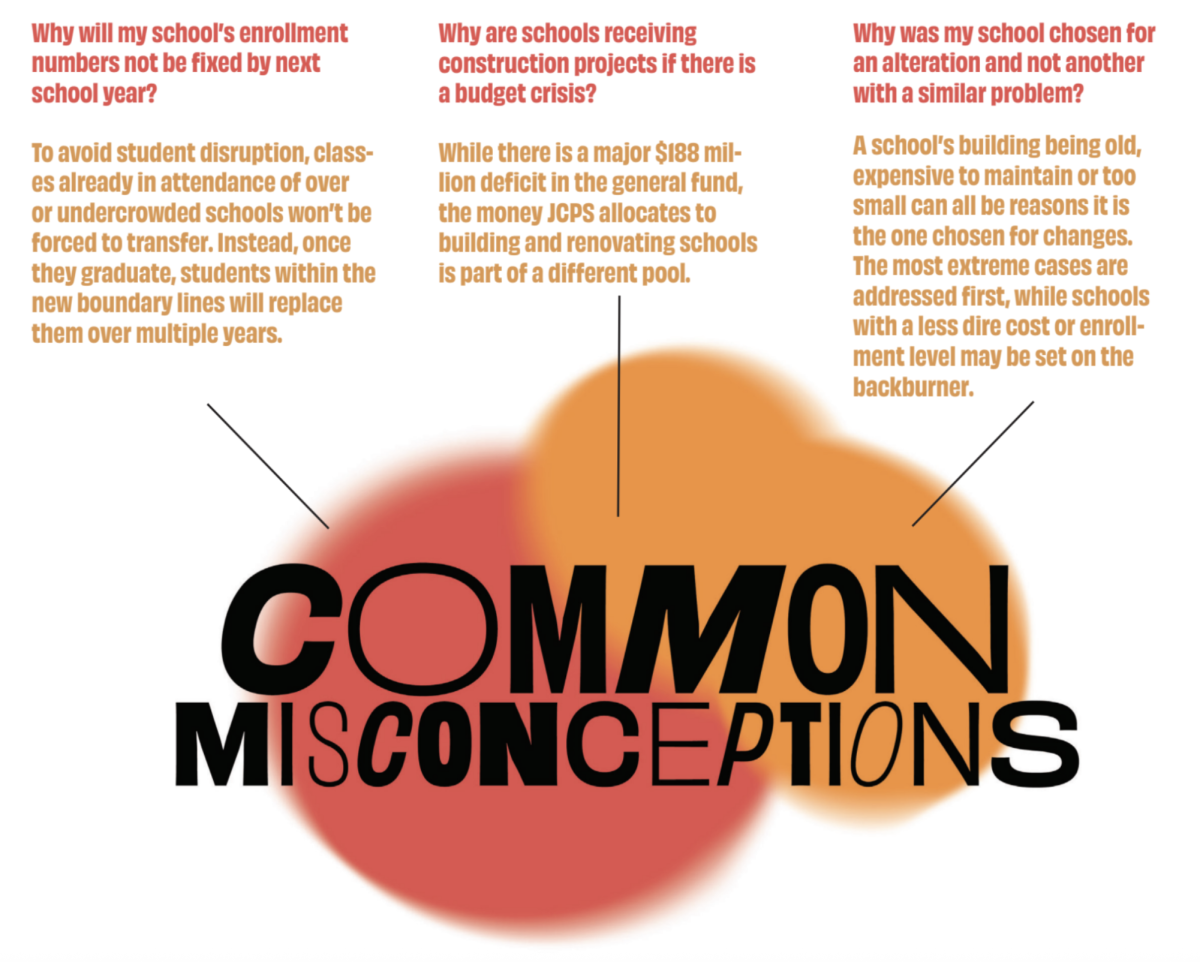
Contrary to popular opinion, the average cost per student increases when schools are under capacity because the schools’ expenses are spread out between fewer students.
These costs include necessities such as electricity, ventilation, water and busing.
“If we’re making a stop on this corner, it really doesn’t matter to us if we pick up one kid or we pick up seven kids, it’s still a stop,” Fulk said. “We’re still spending the same amount of fuel.”
However, this strategy is not without its issues, either. The closure or merging of these schools, particularly Zachary Taylor and King, has sparked pushback from school faculty and parents.
King’s student population is 83% Black, and the proposal of its closure prompted criticism of JCPS choosing to close schools with predominantly minority and underfunded populations.
“King is not just another building in the system,” Johnetta Anderson, a speaker at the March 2026 JCPS school board meeting, said. “It’s a school serving one of the largest populations of African-American students in this part of the district.”
Anderson also said that other schools in the area have similar problems that the proposed changes from November have not adequately addressed.
The closest JCPS schools to King include The Academy at Shawnee and Dr J. Blaine Hudson Middle School, both of which are within a six-block radius.
According to recent budget discussions, King’s cost per student is $33,082, whereas Shawnee’s is $28,486.
Hudson’s cost, on the other hand, is expected to level out next school year.
The school is currently in the building of the former Young Elementary, and, in 2027, it will transition into a new building on 18th and Broadway.
Once it does, its cost per student is expected to drop pretty significantly.
While both Shawnee and Hudson are over the average cost per student in JCPS — $23,553 — King is higher on JCPS’s priority list.
It is not a special case like Hudson and its average cost per student is far higher than Shawnee’s, which is why JCPS chose to make changes before other high-cost schools nearby.
However, due to the $188 million budget deficit, the district lost such a sum for the next year that most of the proposed changes were made on short- notice to families, who in turn felt blindsided.
“It has been my experience that a lot of times when JCPS has an issue, it feels like they believe they’ve got to solve it only within the four walls of JCPS, rather than looking to the community at large,” said Markus Winkler, the representative for Louisville Metro Council District 17.
“When the public perceives that the public school system is not meeting their needs, that is a pretty big barrier to growth,” Winkler said.
Still, that’s not to say the plans don’t have positives. With the changes JCPS is planning to implement, many schools struggling with overcrowding are expected to see a shift into more manageable student numbers.
This will ease the strain not only on district spending, but on teachers and faculty.
At Atherton, new additions to the campus are bringing relief to high-strung staff.
“I’ve been here for 20 years,” Tucker said. “I can’t remember the last time everybody had their own classroom.”
Likewise, those with lacking enrollment are receiving programming to improve their student population.
Over time, the most extreme cases of skewed enrollment numbers are projected to level out.
There’s a long road ahead in terms of repairing JCPS’s image among many of its constituents, but the long-term effects of its plans will be a win in the book of both the district and its students.