As I type this, hundreds of emails sit unopened, collecting dust in my inbox. Some are advertisements for favorite brands, others are newsletters, but most occupy one category: college recruitment.
Loud subject lines, overly optimistic messages, each one beginning with an address to my full name. Scrolling through, they appear almost identical.
Some are from schools I would love to attend. Most are from places I’ve never heard of. Either way, they usually go unread.
For most students my age, the topic of college is inescapable. Teachers, family members, your dentist — everyone is asking where you’re planning on applying.
At the same time, however, these adults seem to have little idea of what the college admissions landscape looks like for high schoolers right now.
Acceptance rates of top colleges are dropping, prices are rising and an unpredictable federal administration is making the feasibility of attendance uncertain.
Schools that many parents would have viewed as unexceptional in their own youth have skyrocketed in rankings, boasting admittance rates in the single digits.
For example, Northeastern University in Boston dropped from a 35.2% acceptance rate for the Class of 2013 to 5.7% for the Class of 2028, and New York University fell from 32% for the Class of 2015 to 8% for the Class of 2028.
Adding to this pressure is the increasing popularity of submitting an early decision application, a binding contract in which you can apply to a school early on the condition that you must attend if accepted.
Applying in an early decision round typically results in a higher likelihood of admittance.
However, if a student chooses to do so, it’s likely that, if they are accepted, they won’t be told how much financial aid they’ll be receiving.
Free Application for Federal Student Aid (FAFSA) deadlines are later in the year, and schools can only calculate what they can give after they’ve finalized their rosters.
This exacerbates pressures on students from low-income backgrounds and gives advantages to those whose aid package isn’t crucial to their attendance.
The inequity of early decision isn’t the only obstacle that students from less affluent families face.
In recent years, rising costs and general economic trends have narrowed access to college for those outside the upper class.
In the 2010s, only 61% of families with a six-figure household income reported crossing a college off the list due to cost. Now, that number is 80%.
Some estimates place the sticker price of college at double what it was 20 years ago. This shift has emphasized class disparities within colleges, solidifying wealthier families’ grasp on higher education.
A 2017 study by Raj Chetty, a professor of economics at Harvard University, found that students from families in the top 1% of earners were 77 times more likely to be admitted into the Ivy League than students from families making less than $30,000 a year.
However, this gap isn’t exclusive to America’s most elite schools. In that same year, Chetty found that, at the University of North Carolina, students from families with incomes in the top 20% were 16 times as numerous as students from families with incomes in the bottom 20%.
Underscoring the severity of this issue is the fact that holding a degree can, on average, increase someone’s lifetime income by hundreds of thousands, making this a self-perpetuating problem.
Topping off the growing list of barriers to higher education are the frequently made federal changes to their operations.
In 2023, the Supreme Court declared the use of affirmative action policies, which gave preference to historically disadvantaged groups in college admissions, unconstitutional.
The next year, California joined four other U.S. states in outlawing the practice of “legacy admissions,” or giving preference to children of alumni in the application process. Both decisions sparked a national debate.
This past spring, massive cuts to the U.S. Department of Education affected the funding and efficiency of several higher education-related services, most notably the Federal Student Aid office.
Over the past several months, the U.S. Department of State has revoked thousands of student visas, and the Trump administration has pulled over $1 billion in federal grant funding from universities across the country.
This has resulted in the endangerment of essential student resources, including after-school activities, summer programs and support for migrant children and English learners.
Students today are dealing with a new set of challenges that their parents, teachers and counselors never had to.
Faced with an unfamiliar landscape, some are adapting. Others flounder.
Either way, many share common questions, problems and anxieties.
Not only are high-ranked colleges now harder to get into, but the path to attendance is crowded with more obstacles than ever before.
As test scores and GPAs rise, the pressure to apply, get accepted to and thrive at a “good” school is becoming suffocating, pushing students into competitive environments and overcommitted schedules.
Pushed to the Limit
I can’t deny that my own involvement in school activities fits the profile of a student stretched too thin.
I’ve been a part of all the typical extracurriculars: model government, student council, a school publication, plus a handful of other engagements. Balancing these commitments, alongside classes and other responsibilities, is a struggle.
I do, however, genuinely enjoy participating in everything I’m a part of.
I’m passionate about civic engagement, journalism and youth empowerment, but managing these passions simultaneously can be a little overwhelming. It feels like if you don’t balance them perfectly, colleges might not recognize them as authentic.
Eleanor Keith, 16, a junior at Assumption High School, understands this weight. Although she hopes to be recruited by a college for soccer, she maintains a strong focus on her academics and extracurriculars.
As a student-athlete, she has multiple pressures to balance when it comes to the college search.
Outside of her sport, she participates in the National Honor Society, the math honor society, Y-Club, the student council and the Environmental Concerns Committee.
“I wouldn’t call it easy, balancing all the stuff I have to do,” Keith said. “Sometimes I do have to sacrifice an hour of sleep.”
Even though she isn’t yet in her senior year, she says she’s seen a handful of similarly-aged peers already signing contracts with schools.

“Sometimes I feel like I’m behind, that I haven’t already committed somewhere,” Keith said.
Comparison is a common vice among students nearing admissions season.
J Pridemore, 17, a senior at Eastern High School, says that seeing college-related content online and speaking to peers about applications, although sometimes helpful, has put pressure on him.
Videos on TikTok and Instagram that share high school students’ “stats” — their GPA, extracurriculars and demographic information — along with the colleges they applied to and where they got in, have garnered millions of views.
Most are from anxious students wondering how they compare to their “competition.”
A popular creator in this category is @limmytalks, a Duke University graduate who lets followers submit their application information and films his reaction for millions to see.
In some of his most recent posts, he reveals the college acceptances of people ranging from a valedictorian, a Harvard student and someone with a perfect ACT score.
“It feels like you have to have the most crazy GPA and a million APs to get into whatever college you want,” Pridemore said. “Most of the people I know have taken APs all four years, and they stack up.”
The impression that college applicants’ GPAs are rising is correct. However, it isn’t completely reflective of overall academic achievement.
According to the ACT Education Corporation, the average high school GPA rose across all subject areas from 2010 to 2022, most notably in math.
However, standardized testing scores reflect the opposite. Reading scores for 12th graders peaked in 2009, and math scores in 2013, with both subjects experiencing a steady decline since then.
This mismatch gives weight to the theory of grade inflation, which posits that students are receiving higher grades now than in the past despite showing the same level of achievement.
But a high GPA is just one of the expectations students must meet to be competitive in college admissions.
“Parents and adults, their memory of college applications is a lot different than how it is now,” Claire Morris, 16, a junior at Kentucky Country Day School (KCD), said. “You have to worry about the SAT, the ACT, your extracurriculars, your sports, are your grades high enough compared to other people?”
Morris says most of the academic pressure she experiences comes from a competitive school culture, where she feels pushed to do as much as she can.
At KCD, she is part of the varsity tennis team, varsity cross country team, math honor society, theatre tech crew, Y-Club, health sciences club, Spanish club, environmental club and a volunteer group she runs called Knitting for NICU. She is also a lifeguard for her local YMCA and volunteers as a youth tennis coach.
“It’s just a part of KCD’s environment,” Morris said. “You want to be the most advanced and most high-level you can be.”
Not every student is comfortable in high-pressure academic communities, however.
“Some people, I feel like they just go and they just try to do everything,” Stanley Alvarez, 18, a senior at duPont Manual High School, said. “It makes you feel like you’re not doing enough.”
The feeling of being left behind is a difficult one to contend with. I’ve felt it. Almost every student has.
At the beginning of every school year, I look back at myself from the year before and gawk at how much stress I was under.
As a sophomore, I realized how silly I was as a freshman to be worrying about involving myself in every club I thought would make me seem accomplished.
As a junior, I know that the constant comparisons I made between myself and my peers last year were completely misguided.
I know next year, I’ll likely have another epiphany about the way I view myself academically now.
Words of Advice
These immense pressures leave students wondering what colleges really look for in the admissions process.
Do they actually want to see overinvolvement? Or is that a red flag? Do they want students to be well-rounded? Or do they prefer someone “pointy,” with a clear specialization?
The short answer is that it’s complicated. Colleges aren’t always clear about what they’re looking for, and it can change from year to year depending on shifting standards and goals.
Different sources will tell you different things.
Some will suggest mapping out a focus area as early as freshman year, others will recommend demonstrating authentic interests and even more will offer a vague in-between.
Some point to extracurriculars as the most important part of an application, and others to GPA and test scores.
According to Dary Picken, a KCD college counselor, his foremost priorities for students are maintaining academics, involving themselves in extracurriculars they’re passionate about and finding a college that fits them rather than the other way around.
“It’s not so much a matter of building your resume,” Picken said. “If soccer’s your thing, join the soccer team. If you like musicals, then sign up for the play.”
Picken recognizes that there’s a lot of pressure for students to get into schools that are regarded as “good” by their peers, families and future employers.
However, he also believes that most students will end up in the right place regardless of their “stats.”
“Ultimately, that’s the statistic that we care the most about here is, like I said earlier, that people are happy,” Picken said.
For those who are still set on attending highly competitive schools, he has advice.
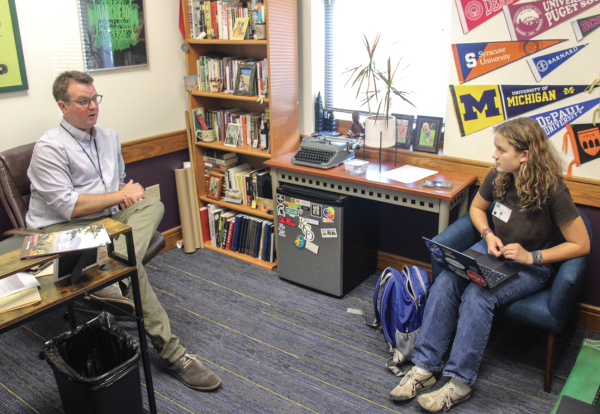
“Do you love it because it’s prestigious, or do you love it because of the architecture of the campus, or its area of the country, the weather, proximity to home? Do you love it because every student there who applies to medical school is admitted?” Picken said. “Because if those are the things you’re looking for, I can find those categories for you in a school that doesn’t reject 95% of its applicants.”
Lessons Learned
Of course, there are plenty of students who still choose to apply to schools that reject almost all their applicants, despite the slim odds.
Lauren Wood, 20, is a junior at Harvard, majoring in social studies. Her application was one of the 1,942 accepted out of an applicant pool of almost 57,000 for her class.
She achieved what so many high schoolers dream of — she got in. However, it wasn’t easy.
“I think I definitely overcommitted in high school,” Wood said. “There were just times when I was so stressed out, and it was affecting my functioning at school, and I wasn’t getting enough sleep.”
Wood attended Manual, a magnet school that attracts students from across Jefferson County and beyond.
It’s known for its rigorous courses and high academic standards, which Wood says contributed to the pressure to excel and do more.
Now, as a college student, she has stepped back from her commitments in order to focus on a healthier work-life balance.
“I have tons of free time now, I get sleep,” Wood said. “I really only want to be engaged in things that make me feel more fulfilled, not things that drain me.”
Her biggest advice to seniors submitting their applications is to be genuine.
“The people reading your application are really, truly just interested in who you are and what you would contribute to campus,” Wood said. “They’re not interested in you playing up this thing that’s not actually authentic to you.”
Decision Day
Going to college can be terrifying, but also thrilling. It represents the end of your childhood, but also a new beginning. It will change your life, but it isn’t your end-all-be-all.
The dream school you decided on in your freshman year of high school might not be where you end up going. The major you declare on your application probably won’t be the one you stay with through graduation.
There’s a good chance a four-year college, or any college, may not be your ideal fit at all. And there’s just as strong a chance that the version of success you pictured will evolve as you discover what truly matters to you. In fact, 50% of college students change majors.
As a junior, I still have some time to figure things out. I’m not knee-deep in the Common App like seniors I know. Once I do get to that point, though, I’ll know what I’m looking for.
I won’t be looking for a sliver of an acceptance rate, name recognition or affirmation from friends and family. I’ll be looking for a place that feels like home — somewhere I can see myself living, changing and growing.
Because that’s the point of college in the first place: to learn about yourself and the world around you.