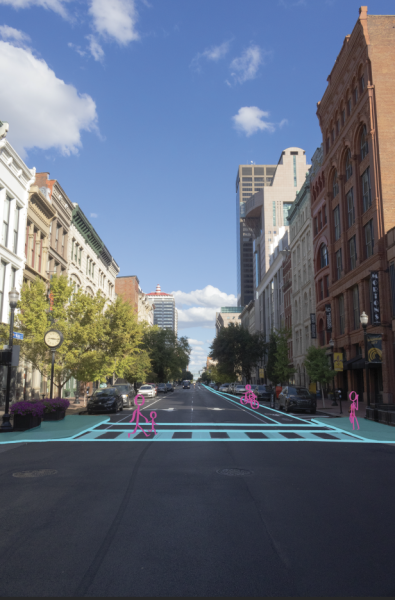

Simply put, you can’t find the definition of walkability in a dictionary.
Up until recently, I assumed that if someone could walk somewhere, that place could be considered walkable. “Walkability” is a clear-cut combination of the two words “walk” and “ability,” so it seemed that the word itself could be interpreted as something along the lines of “the quality of a place where there is an ability to walk.”
The problem with my adoption of this definition is that there is no definitive quality. Thus, I looked for the answer to my question in Merriam-Webster. As it turns out, it had none, and nor did any other dictionary.
“It’s hard to define, so that means it’s hard to study,” said Lauren Anderson, a research manager for the Christina Lee Brown Envirome Institute at the University of Louisville.
But that doesn’t mean people haven’t tried.
According to the website Walk Score, Louisville’s current overall “walk score” is 34.3 out of 100 and is ranked 43rd among major U.S. cities. For instance, San Francisco and New York have scores of 89 and 88, respectively. For a more local perspective, Louisville’s is the same as Lexington’s and ranks lower than Cincinnati’s.
Because of this, Louisville’s leaders are taking major steps to improve its walkability.
Initiatives such as Vision Zero and the Downtown and NuLu Walkability Plan aim to protect residents’ safety, whereas the ongoing construction of the Louisville Loop works to directly benefit walk-in businesses and public health.
While all target the same end goal, each is taking a different stance on what exactly walkability entails.
But what does this mean?
Using quantitative measures, Walk Score views walkability as the degree to which people can reasonably access amenities on foot. The walk score is calculated based on the distance between a point of origin and facilities such as grocery stores, restaurants, childcare centers and pharmacies. Higher-scoring areas have closer amenities, and vice versa.
The walk score within Louisville varies greatly, with downtown, NuLu, the Highlands and Phoenix Hill ranking the highest. Louisville’s lowest scores are in Fern Creek, Valley Station, Highview and Fairdale. The further the neighborhoods are from downtown, the lower their walkability generally is.
Urban sprawl, which occurs as a city’s population disperses from its central core, reduces density in areas further from downtown. Walk Score deems a place with a score below 49 as largely car-dependent, a category to which over half of Louisville’s listed neighborhoods — 38 out of the 71 — fall.
“The Walkable Neighborhood,” a 2017 literature review, examined over 200 research articles and found that most studies observed important relationships between physical health and walking.
In 2016, the National Institutes of Health also reported numerous advantages of regular walking, including improvements in mental and physical health, as well as a reduction in the risk of chronic disease.
For the younger generation, this aspect of walking becomes even more important due to its critical timing. Childhood and adolescence not only affect who we are today, but also who we will be in the future. A person’s upbringing in Louisville shapes the city’s current children, teens and young adults, and will continue to do so. This powerful influence encompasses all areas of life.
In 2025, Alyas Widita, a researcher at Monash University specializing in urban movement and design, reported that the walkability of one’s childhood environment is at the heart of their perceptions of walking later on. This can substantially affect overall health and longevity.
Thomas David, 15, a sophomore at Ballard High School, lives in downtown Louisville. He enjoys exploring the city on foot and visiting various landmarks and entertainment venues. David said that he walks downtown almost every day.
“I feel comfortable,” David said. “It’s never been a problem because there’s not a lot of bad parts.”
Unfortunately, he is not the model for how many youth in Louisville are willing or able to walk.
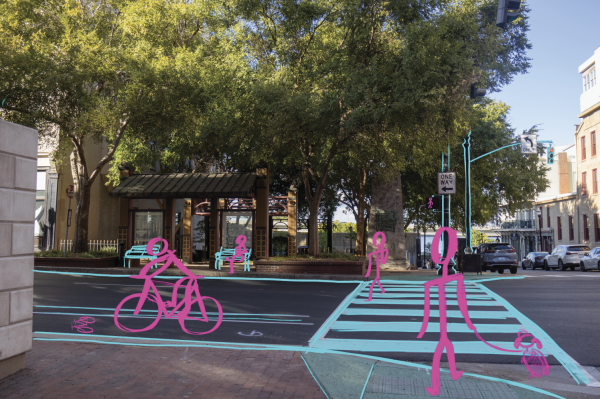
(Photos by Suzetta Fuller)
Quality over Quantity
At the core of walkability is the notion that people will walk.
A 2025 report from the University of Washington detailed that, across relocations, “when the walk score rose or fell more than 48 points, average steps increased or decreased by about 1,100 per day.” This reveals a tangible relationship between a walk score and actually walking.
However, studies like this one have the issue of self-selection bias.
“People who like to walk are more likely to self-select into a neighborhood that’s walkable,” Anderson said. “So we don’t know how much of health benefits from walkability are really from that environment versus someone is just sort of already wired to want to walk and want to be healthier.”
Defining walkability solely through quantitative measurements, such as a walk score, does not always present the whole story when it comes to whether all people are truly using the infrastructure. It discounts the qualitative factors that contribute to the walkability of an area.
Julia Koschinsky and Emily Talen, authors of “The Walkable Neighborhood” reported that walkability-based research that only addresses quantitative factors can be problematic.
Crime is one example of a qualitative factor that influences walkability. Others include the presence of nature, shade, the attractiveness of the area, perceived safety and the desirability of different amenities. Plans aimed at improving Louisville’s walkability approach it with these aspects in mind.
Street Smarts
Running down West Burnett Avenue in Germantown, I noticed a point of orange hovering above the sidewalk ahead of me. As I approached the diamond-like shape and an ominous black-mesh fence barricading the road next to it, I could begin to read the words on the sign: “Sidewalk Closed.”
Other Louisvillians have noticed this change, too.
“I think that living downtown gives more of an inside scoop on the transportation and benefits Louisville has,” David said. “But in some areas sidewalk-wise, can get messy in spaces where streets haven’t been refined.”
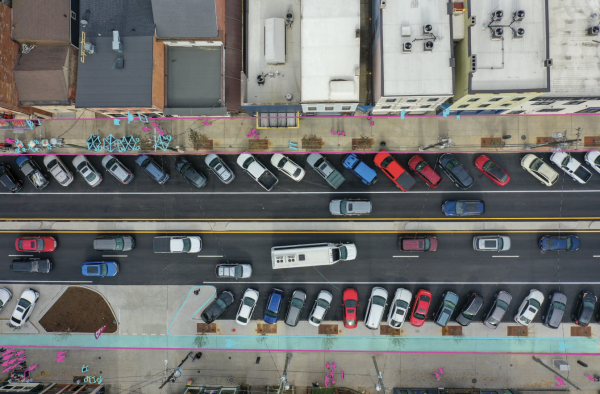
Currently, Louisville is undergoing reconstruction. The Downtown and NuLu Walkability Plan is converting many roads into two-way streets to slow down traffic and enhance pedestrian safety in Louisville. This coincides with similar efforts from the local chapter of Vision Zero.
“Vision Zero Louisville is the city’s transportation safety initiative,” said Claire Yates, a transportation planner for the Louisville Metro Department of Transportation (DOT). “Louisville Metro Council passed an ordinance envisioning zero roadway deaths by 2050, and so that’s what we’ve set out to do.”
According to an annual report from Vision Zero Louisville, within Jefferson County, there was a 26% increase in pedestrian deaths on non-interstate roads from 2023 to 2024.
The foundation of both the Downtown and NuLu Walkability Plan and Vision Zero is to improve pedestrian safety by modifying the built environment.
“If a roadway does not have sidewalks or any sort of lighting, but we know that there’s pedestrian activity, obviously they would absolutely need to have both of those two critical pieces,” Yates said.
Two-way street conversions and the replacement of stop lights with stop signs are the specific changes that the Downtown and NuLu Walkability Plan is targeting.
Although downtown and Nulu have the two highest walk scores in Louisville, at the core of it all, it is people themselves who decide whether the area is walkable or not.
“If you live in a place that’s very hot, if there’s no trees there and if there’s no destinations, and all the people around you are driving really fast, you are not going to be walking anywhere,” Anderson said. “You are not going to be getting exercise, and that is one of the ways that these built environment characteristics limit and shape health behaviors and outcomes.”
For stakeholders such as the Convention and Visitors Bureau and local advocates like Streets for People, their biggest concern is safety.
“They really want to see a safer, more comfortable place for people to walk through downtown,” Michael King, the assistant director of the Louisville Metro DOT, said. “That’s kind of the driving force behind all of this.”
The hope for this project is that more people will walk if the area they are walking in is safer.
The Louisville Loop is another project aimed at improving the city’s walkability, focusing on areas with a notably low degree of it. The Loop, an initiative conceived in the early 1990s, will encompass over 100 miles of mixed bike and pedestrian trails traveling the circumference of Louisville. Approximately 50 miles are completed to date, including 25 contiguous miles in the Parklands.
“It will provide additional tremendous opportunities to get out of your vehicles and walk or bike,” John Swintoski, a landscape director at the Louisville Metro DOT, said. “Human-powered transportation is one of the healthiest activities that people can take, and the great thing about the Loop is it’s built for all abilities.”
Their website detailed that, once the Loop is finished, it will be within a mile of 66% of residents and 42% of public schools. In addition, it will bring new business and tourism to the area.
Under current plans, the Loop will pass through multiple neighborhoods on the outer reaches of Louisville, including Fern Creek, Highview, Fairdale and Valley Station. This will greatly increase access to attractive and nature-immersive infrastructure in these low-walkability areas.
Although the reasons that youth walk in the city vary, more often than not, walking has been associated with practicality rather than pleasure. The aims of the Louisville Loop, the Downtown and NuLu Walkability Plan and Vision Zero are to improve walkability in the core of Louisville and at its furthest reaches.
This could provide young people with a safer place to walk downtown and the ability to explore more of what the area has to offer. Additionally, in more outlying neighborhoods, teens could gain the opportunity to walk to school or new businesses that the Loop would attract.
But it’s not only walkability that can be improved. So too can its definition. To put it in Anderson’s words, “When we talk about walkability, what we mean is, how safe is it, and how likely, really, it is that someone will be walking around.”
The qualities that contribute to the walkability of an area can vary tremendously, and my presumptuous definition desires to lump all of these together. At the end of the day, what truly defines walkability is whether or not anyone is actually going to walk.