It’s Dec. 6, 1995, early in the morning on Lexington Road. The streets are silent, and many businesses are just starting to open their doors.
Mandell Clark, 17 at the time, sits behind the building he had planned to rob weeks earlier with a friend. The plan was to escape after robbing the store, just before the streets filled with people.
Though hidden from view, he can watch what’s happening around him.
It’s around 4:50 a.m. when Clark sees his victim, the manager of the store he was going to rob. As he gets out of his car and walks up to unlock the store, Clark swiftly emerges from hiding.
Clark grabs him, presses a gun to his body and pushes him into the store.
The man leads Clark to the manager’s office, where Clark forces him onto the floor, flat on his stomach, and asks him for the code to the safe inside.
By 5:05, Clark is out the door, ready to leave. However, his driver isn’t there, leaving him stranded. He flees on foot. Minutes later, he is caught by a civilian who noticed his suspicious behavior.
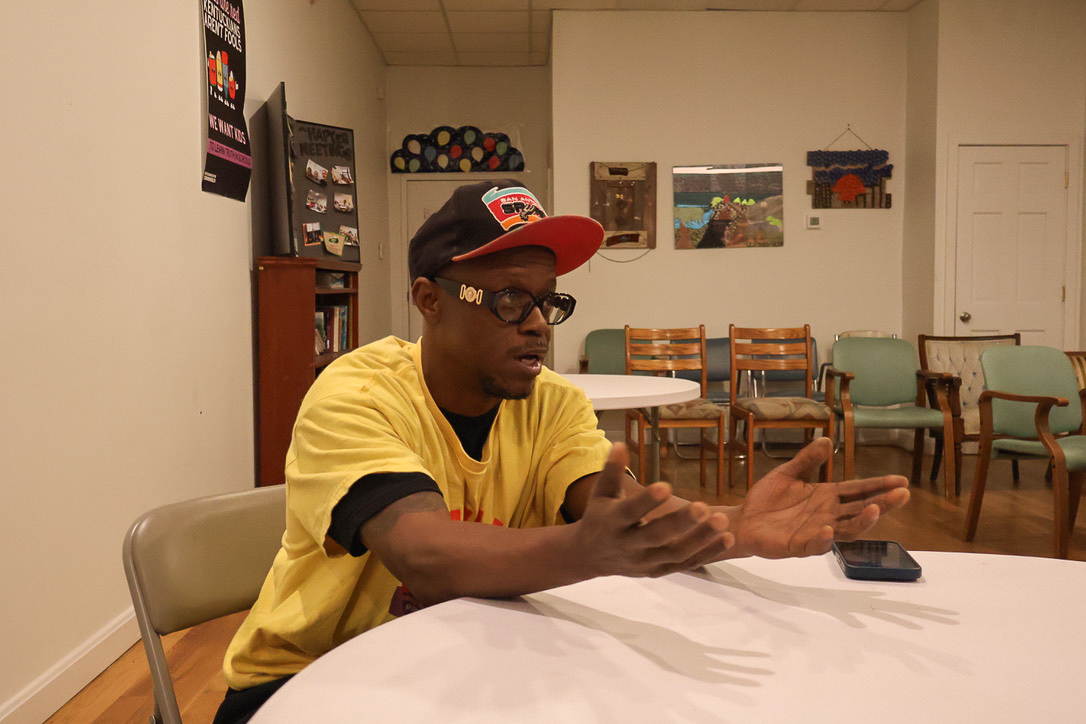
Despite being underage at the time of the crime, Clark was tried as an adult and sentenced to 12 years in prison for first-degree armed robbery.
“I made an irrational decision,” Clark said. “Became a product of the state.”
Clark received his sentence in 1996, at a time when the existing criminal theory rested in the idea that harsher punishments would reduce crime.
Legislation during this time made it easier for minors to be transferred to adult courts, lowering the age of liability for certain crimes.
This trend continued throughout the early 2000s, but began to shift in the 2010s.
With “softer on crime” policies and a focus on rehabilitation and diversion, the court system decreased youth commitments, therefore reducing the number of kids caught in a cycle of incarceration.
However, many of these policies have now been rescinded, returning the court landscape to that of Clark’s time.
In the 90s, Kentucky’s “firearm clause” stated that if a gun was used in a felony, children 14 or older would be automatically transferred to an adult court.
Though the number of minors being committed to the Department of Juvenile Justice (DJJ) during this time was generally lower, kids in out-of-home placements were on the rise.
In 2012, the Kentucky General Assembly established the Task Force on the Unified Juvenile Code to address this issue.
In 2014, the Kentucky General Assembly used information from the group and passed Senate Bill 200, aiming to “reduce the number of children interacting with the formal court system” and “reduc[e] expenses for the state,” according to the Kentucky Center for Economic Policy (KCEP).
However, 10 years later, false claims of a “juvenile crime wave” influenced the passage of two “tough on crime” bills.
One of these was Senate Bill 20 (SB20), which mandated that individuals 15 years or older who are charged with a Class A, B or C felony involving the use of a firearm are automatically tried as an adult, echoing the practices of the 90s.
While harsher punishments might seem like a good way to stop crime, SB20 doesn’t recognize why children are committing them in the first place.
After witnessing how the Kentucky court system handled both his and his daughter’s cases, Clark, now 48, believes that Kentucky has been failing its youth by assuming their stories before they get the full picture.
Beneath the Surface
When looking at Clark’s story specifically, there’s much more to unpack about his life leading up to his crime.
When Clark was around 6 or 7 years old, his parents separated, and not long after, his father moved him and his older sister from Louisville to St. Louis. Clark tried not to let these changes affect him, but after his mother passed away just a year later, it was hard not to.
He then moved back to Louisville, faced with the devastating loss of a parent. His father struggled emotionally, and Clark watched as his family dynamics crumbled.
As a result, Clark developed a severe stutter, which led to bullying and teasing by peers at school and in his community.
He began experiencing depressive states, which continued throughout his childhood. Clark recalls having a few family members there to support him, one of these being his father, whom he considered to be his best friend. However, this support system soon collapsed as well.
At 17 years old, his father died, and after the loss, there was a shift; he began getting more and more aggressive.
“I lost my best friend,” Clark said. “I didn’t have the correct resources to channel my anger.”
But stories like Clark’s aren’t nearly as talked about as the crimes themselves.
Instead, legislation like SB20 focuses on punishment, rather than the cause of the defendant’s behavior, which has the potential to lead them down paths of crime. A 2019 study from the National Society for the Prevention of Cruelty to Children found that traumatizing experiences have a lasting impact on youth emotionally and impair the development of the prefrontal cortex, the part of the brain that helps regulate decision-making and impulse control.
Youth who experience these traumas are more likely to engage in harmful coping mechanisms and may act more impulsively or exhibit aggression.
Laws like SB20 don’t consider how both childhood trauma and poor environments impact youth, especially in minority groups.
Sociologists have long theorized that areas with higher poverty may be more prone to higher crime rates.
A 2025 study from the Mediterranean Journal of Social Sciences found that income inequality and unemployment are indicative of criminal behaviors and crime.
Some theories further suggest this can lead residents to commit “survival crimes,” acts such as theft and drug trafficking which can create enough money to pay bills or feed families. Survival crimes are also a major factor in the youth-related crimes committed in these areas.
Though he now looks back at his actions with regret, at the time, Clark believed his crime would help his community.
“My crimes I’ve always done was never against people that look like me. Not saying that people that don’t look like me deserve what I was doing, that’s not what I’m saying, but for me, at that time frame, majority of the financial money flow was past the Bardstown Road exit, going east,” Clark said. “My community empowered me to become a bootleg Robin Hood, because I went to their neighborhood and brought back to mine.”
The emotional and social environment that one grows up in can influence the actions they take, but the historical and stereotypical beliefs of people outside those communities can also have negative impacts on the lives of youth—both those who have committed crimes and not.
West End residents have faced harmful legislation for decades, one of which is redlining. In the 1930s, banks and insurance companies began deeming majority-Black neighborhoods as “hazardous” and refused to fund them.
Despite its eradication in 1968 under the Fair Housing Act, its impact, especially in Louisville, still stunts the economic growth of these neighborhoods.
Clark believes that these negative views of West End residents still exist today, and that they were part of what shaped his conviction.
He believes that the court saw him as solely a criminal due to the neighborhood he grew up in, rather than an individual shaped by his background and lived experience.
If a defendant is a minor, their legal counsel could argue for diversion—community involvement-based punishment rather than threat of confinement and legal action or alternative probationary measures.
Clark believes that this should have been more heavily considered in his case.
“My crime was committed in the East End, not my neighborhood,” Clark said. “So they gave me a charge I couldn’t get out for.” Since his crime was classified as a Class B felony due to the use of a firearm, it would have been unlikely even with SB20’s community-based policies that he would have been diverted.
For kids across the state, however, diversion could change the course of their life.
While no definitive proof exists showing that Kentucky’s judicial system is attempting to push minorities into jail cells due to stereotypical beliefs, racial disparities in youth crime rates and incarceration patterns continue to appear more frequently in economically disadvantaged neighborhoods with larger minority populations.
In 2024, when SB20 went into effect, Black children accounted for 43% of the nearly 500 children who were prosecuted as adults across Kentucky, even though they make up under 9% of Kentucky’s population.
The task force discussed this disparity over ten years prior.
By focusing less on commitments and more on out-of-home placements, they discovered that, due to the cyclical nature of the court system and a lack of crime-fitting punishments, minorities within certain environments were more likely to be incarcerated.
Through its research, the task force found that not only were over half of the kids in these placements charged with misdemeanor or status—crimes for minors but not for adults, such as running away or truancy offenses—but those charged with actual felony offenses were mostly Class D, the lowest level.
On top of this, the time spent in these placements for the misdemeanor charges compared to the felony ones had less than a month of difference, meaning that, regardless of the crime, the punishment was similar.
According to the KCEP, the longer someone remains in a detention center or out-of-home placement, the rates of recidivism increases. Recidivism is when a person who has been previously in the system returns within a couple years.
If those who committed lower level felonies or misdemeanors have similar detention rates, regardless of their crime, they are statistically more likely to become reinvolved with the system.
According to USA Facts, “more than eight out of every 10 youth offenders are arrested again within five years of release.”
This time and experience in detention can also be considered a trauma, just as trauma may have led them to commit a crime in the first place.
These factors reduce kids’ ability to gain a quality education and pursue successful employment.
The KCEP cited a publication which summarized studies over the past decade, and found that “incarceration does not reduce delinquent behavior, and confinement most often results in higher rates of rearrest compared with other community-based alternatives.”
SB20 worked to address this community-based approach, but due to insufficient funding, their efforts fell short—though they still managed to divert many kids and reduce costs.
However, due to SB20, in a four month period in 2024, “the number of children detained had increased by 17% year-over-year, with a 30% increase in Jefferson County…although total complaints filed had only increased 6%.”
Still, the bill and community advocates are working to curb youth crime and disrupt the seemingly generational cycle by funding opportunities for teens in the West End.
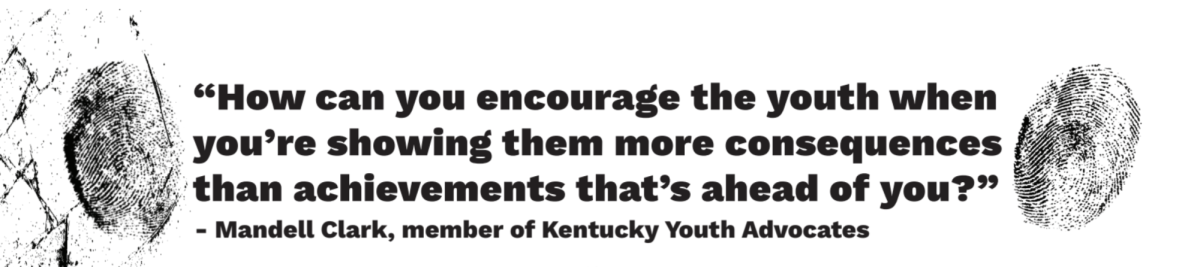
“How can you encourage the youth when you’re showing them more consequences than achievements that’s ahead of you?” Clark said.
Some might argue that Clark’s beliefs in shifting to a resource and aid-based system encourage more criminal behavior.
However, according to the Children’s Law Center of Kentucky, minors transferred to adult court are 34% more likely to commit additional felonies than children in the juvenile system for similar offenses.
This demonstrates that harsher punishment legislation, like SB20, has a history of creating repeat offenders.
Clark believes that aiding youth who are susceptible to crime requires intervention from those who understand their struggle firsthand.
This belief is part of what shapes Clark’s work with the Kentucky Youth Advocates, an organization that lobbies for legislative policies to benefit Kentucky children.
“My sole purpose and drive is to make sure that those that look like me and those that can relate like me will one day actually have justice completed,” Clark said.
A Different Path
Warning: this section contains descriptive language that includes the following topics: sexual assault and abuse.
Re’ell Clark, Mandell’s daughter, was born on April 13, 2010, almost five years after her father was released from prison.
Mandell struggled with managing the perceptions and stigmas surrounding having a biracial child.
“I had a child with a Caucasian woman, so my struggle was harder than most,” Clark said. “But overall, there’s nothing greater than fatherhood.”
As Re’ell and her questions grew, Mandell strove to shield her from discrimination and criticism due to her race.
On top of that struggle, Mandell hadn’t been able to spend much time with her.
Initially, in Re’ell’s early years, she lived with her mother, her mom’s boyfriend and his kids on weekdays. Mandell was only able to get custody on certain days and weekends, making it harder to connect with her on the same level.
However, she remained close with both parents, until her relationship with her mother became strained.
“When I grew up towards 7 all the way up to 9, 10 maybe, is when our relationship kind of went downhill,” Re’ell said. “I was growing up, I had hormones and I was hitting puberty.”
Simultaneously, the environment within the household turned tense, and she recalled her mom and her stepdad often arguing. This toxic home life would soon become the root cause of Re’ell’s trauma.
She alleges that one night, after she fell asleep while watching a movie, her stepdad sexually assaulted her when her mother was not in the room.
“He was stronger and bigger and taller than me, and I was a little girl,” Re’ell said. “He could fit his hand, like half of his hand, around my waist. That’s how small I was.”
Afterwards, Re’ell remembers just lying there, feeling lifeless.
“I couldn’t feel anything,” Re’ell said.
After she built up the courage to tell her mom, she said her mother didn’t fully believe her.
The next weekend, she spent time at Mandell’s house, and later that night, she had the courage to tell her stepmother.
After confirming that Re’ell had already talked to her mother, her stepmother encouraged her to tell her father.
“I don’t promote violence,” Mandell said. “But on that day, I wanted to put him in the ground.”
After that morning, Mandell took every legal action he needed to ensure that his daughter would be out of that environment and that he would get full custody.
Even after Re’ell moved in full-time with her father, the nightmare was far from over.
In those first few years, she experienced mental health struggles, resulting in changes to her personality and an angrier outlook on life. These traits are commonly exhibited by young victims of traumatic experiences without proper support.
“I had really bad depression, and my mental health was so downhill because a toxic household does that to you,” Re’ell said. “I did try to commit suicide a few times.”
Mandell decided to get her into therapy to talk to someone he thought she could connect with. At first, Re’ell resisted treatment, but the more she talked, the more comfortable she became.
“Honestly, therapy was the best thing that my parents could have done for me because knowing that somebody out there who actually cares and is willing to listen to you even through the days that you don’t want to talk just helps,” Re’ell said. “It helped a lot.”
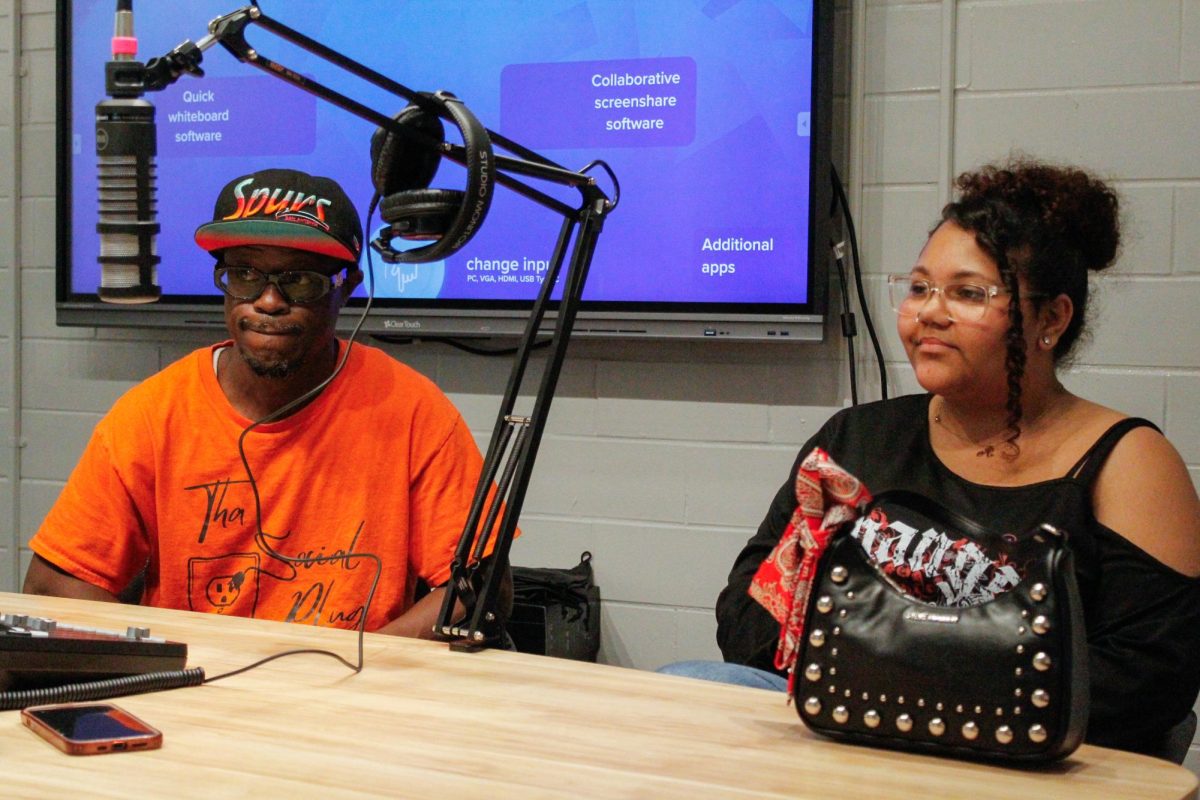
Now a 16-year-old sophomore at Pleasure Ridge Park High School (PRP), she is focusing on finding her passion.
She’s in choir and recently performed at some of the school’s talent shows. Even though she was worried at first, she took the risk to do the things she loves.
“This year, I got outside of my comfort zone and decided to take the rest of my two years at PRP and do choir,” Re’ell said.
Her success with therapy reflects Mandell’s belief that the way to stop youth-involved crime is not through worse punishments, but proper rehabilitation.
However, he doesn’t think the courtrooms recognize this or take action to provide this aid to youth.
“What rehabilitation is defined in the dictionary does not match up in the courtrooms, nor does it match up in real life,” Clark said.
But this is not the direction taken by Kentucky legislators.
Mandell opposes SB20, believing that more people should opt to give youth proper rehabilitation resources, especially in areas with high poverty and crime rates.
However, many JCPS students don’t have the means to access these resources, let alone afford them.
Thus, they rely on school-based mental health practitioners (MHPs) and local government initiatives—two programs whose funding has been called into question due to recent proposed budget cuts.
Though it eventually reversed this decision, JCPS considered it in order to address its $188 million budget deficit. As the district carries a remaining $82 million shortfall into next year, it’s unclear what support or resources it will be able to provide in the future.
While the district didn’t follow through on some reductions, the Kentucky General Assembly approved a $7 million cut from the Department of Education’s budget for school-based mental health service providers.
This likely means that fewer students in JCPS will have access to the resources that Mandell believes kept Re’ell from going down the same path of crime that he did.
On Pain & Progress
In his interview, Mandell emphasized one number: 157,776.
“157,776 hours, that’s what fatherhood means to me,” Mandell said.
It represents the number of hours between the time Re’ell was born and the time she will turn 18.
Clark explained that undergoing trauma or going to prison subtracts the years of genuine childhood from this number. He found himself constantly thinking about his lost time with Re’ell, and the time youth across the state would never get back.
The Kentucky judicial system is failing the people in these communities. It fails not just in its foundation, but in its refusal to listen to impacted voices and see a new perspective.
Stories like Mandell and Re’ell’s aren’t often heard when discussing legislation and court decisions. But because these voices stay unheard, the vicious cycle of youth-involved crime continues.