
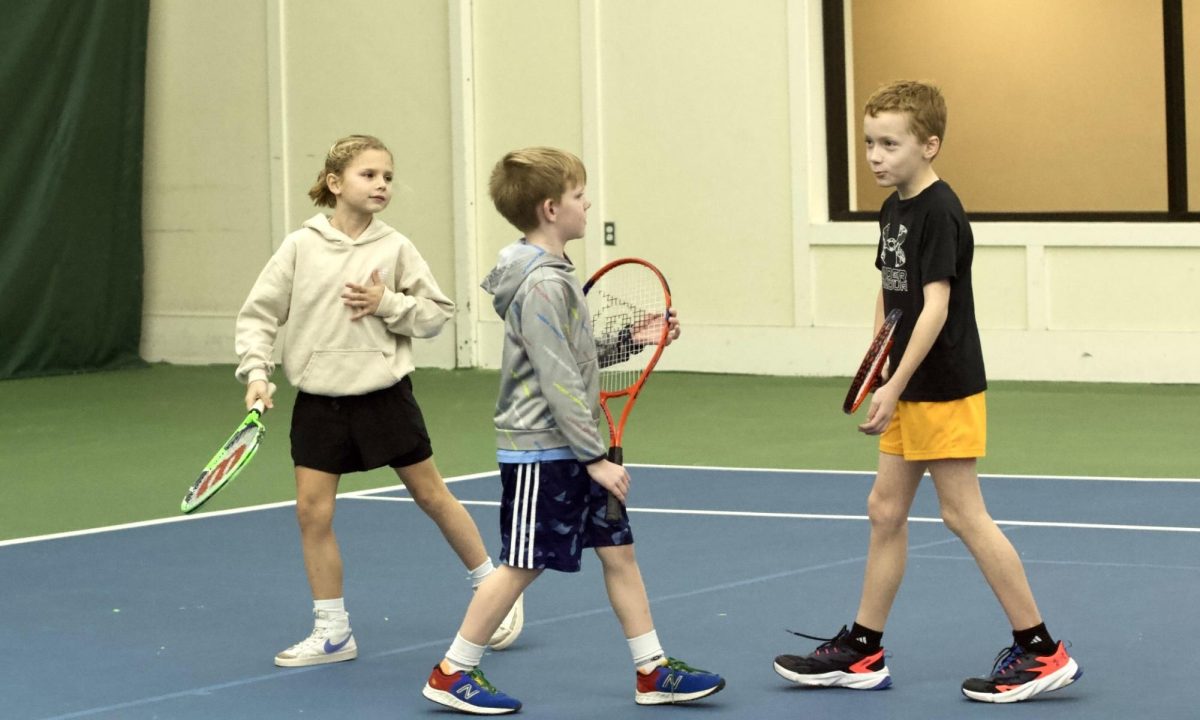
“Alright, balls up!” the coach declared. Almost instantly, the thud of tennis balls halted. Giggling children rushed around the court, hustling to dump them in the basket and run back to their coach. After a quick meeting, practice was over, and most of the kids eagerly sprinted away to greet their smiling parents.
But one hesitated to walk out, his eyes glued to the older group on the court next to him. Even though they seemed to be having fun, their skill was indiscreetly apparent. While hitting at highway speeds, they were simultaneously chatting and teasing each other, as if the rapid back-and-forth was nothing. It was an odd but powerful contrast.
They were the Louisville Tennis Club’s “elite” focus group, comprised of some of the top tennis athletes in the state. I didn’t blame the younger player for pausing; it was hard not to watch. After a few more minutes of playing, the teenagers’ coach called for a break, and they jogged over to the benches for water and cooling down.
As the child began to walk off the court, James Watkins, another coach, approached him.
“You’ll be here one day, little guy,” Watkins said. “You will be here one day.”
Even though the boy might not have understood the full implications of what Watkins said, the statement resonated with me.
After seeing the stark contrast between the younger players’ amateur attempts and the elite group’s skilled shots, I couldn’t help but wonder: how do kids even reach that point?
Pressure to Pivot
If you asked most people, they would likely say that children need to focus on training in one sport to become successful. The recent rise of specialization, or the intensive focus on a single sport through vigorous training, reflects this common idea. It often uses adult-controlled programming to advance players’ skills and involves private clubs and coaches instead of recreational play.
However, this hasn’t always been the dominant model for youth sports. According to an article from the Journal of the Pediatric Orthopaedic Society of North America, sports have drastically changed within the last 10 years, with seasonal school-based sports becoming less popular than year-round private clubs.
Kyle Bowling, who owns Kentucky Sports Clinic and works on the University of Kentucky sports staff, has noticed this recent shift. Now, kids aren’t only playing during their school’s season — what’s considered the off-season isn’t a break as much as an opportunity to transition to private training.
“It’s very dialed up, specifically over the last 10 years,” Bowling said. “There’s no downtime.”
But this doesn’t stop parents and kids from buying into the idea of specialization. The concept sounds promising, and with an increase in clubs and programs focusing on skill development at young ages, it’s hard not to feel the pressure.
Jason Dierking, the director of sports performance for Olympic sports at the University of Louisville and a parent of two, recognizes the thought process that prompts many families to join the trend.
“If everybody else is doing it, I have to get my kid into it because I don’t want my kid to be left out,” Dierking said.
Despite the rise of specialization, Dierking has decided against encouraging his children to choose a focus early.
“The trend is going in a very negative direction,” Dierking said. “The exposure too soon, the specialization too soon, the pressure too soon.”
Muscle Memory
One of the most prominent downsides of early sports specialization is the physical risk.
Because it requires intense, year-round training, overuse injuries are common.
Brooke Codey, 16, a sophomore at Assumption High School, plays indoor volleyball for Kentucky Indiana Volleyball Academy (KIVA) in addition to beach volleyball. She has experienced problems from overuse. Codey has patellar tendonitis, also known as jumper’s knee, in both of her knees, is a result of playing frequently. This has been a recurring issue for three years, and she now plays with a compression sleeve at each practice and tournament. She has experienced extensive problems from overuse.
Melissa Starck-Bean coaches Codey and numerous other athletes at KIVA. She says that the same injuries are frequent across a lot of her players. KIVA is a nationally high-performing club, so many of their athletes specialized at very young ages.
KIVA clinics and programs begin at age three, and national teams begin at age 10, increasing the pressure to commit to volleyball young. Specialization’s harm is reflected in the players’ physical issues.
“I think all these kids have the same injuries. They’re all having shoulder injuries and knee injuries, which is a direct thing of volleyball,” Starck-Bean said. “But I think if they were playing multiple sports and strengthening other things around their shoulder, whatever, then I think we wouldn’t have the same injuries.”
Multisport athletes are, in fact, at a lower risk of these types of repetitive injuries. One study by the University of Wisconsin found that non-specialized high school athletes had nearly half the rates of repetitive-use injuries when compared to those who specialized.
Athletes who specialize often disregard physical risks because they believe playing multiple sports inhibits progression in one.
However, this isn’t necessarily true. According to Dierking, working muscles in a variety of ways has been proven to improve a range of athletic abilities.
“Overall athleticism generally lends to more resilience,” Dierking said. “It allows you an off-season to try to pursue other opportunities, let your body recover.”
Because different sports have respective seasons, athletes have more time to recharge, reducing the risk of injury.
As a sports chiropractor, Bowling says he can easily see the difference between multisport athletes and specialized athletes can be seen simply by conducting a functional movement assessment of stability and mobility. Multisport athletes generally perform better because they practice a variety of movements through different activities and exercise.
Sports demand muscle usage in unique ways, which helps strengthen different body systems. For example, running is unidirectional and mainly uses leg muscles to drive momentum forward, while tennis players move in lateral directions and therefore use those muscles differently. By focusing on one sport, athletes perform repetitive motions, which contribute to injury risk.
“Your body really only adapts to what you’re asking it to do,” Bowling said. “So if you’re doing the same movement over and over again, that’s where it tends to get hurt.”
For sports professionals like Bowling, the harm of specialization outweighs the chance of lasting success.
“There’s just so much that has to take place between when you’re nine and when you’re a junior, sophomore, senior in high school, where colleges are looking at you,” Bowling said. “It’s just a risky path to take.”
Mental Gymnastics
It’s not just athletes’ bodies that face exhaustion from repetition — it’s their minds as well.
“There’s a whole other aspect of that, too, that’s not just physical, it’s social, emotional,” Dierking said. “That whole side of it is, I think, worse than even maybe the physical unintended consequences.”
Codey first began playing volleyball when she was 11 years old and trains for approximately 14 hours a week. This doesn’t include the several extra hours she spends at games, tournaments or competitions.
She knows firsthand the effects of committing to a sport so young, including burnout, which has led her to reconsider her decision to participate in the sport.
“Multiple times, I have thought about ‘Why am I here? Why am I doing this?’” Codey said.
Youth specifically are at greater risk for adverse effects. Some may begin to associate performance with self-worth, which is correlated with mental health issues such as anxiety and depression. However, the risks vary based on young athletes’ environments, as supportive coaches and parents may help reduce pressure and, in turn, the harmful effects.


Elle Cargould, 17, is a senior at North Oldham High School. She’s been running cross country and track since elementary school and is now committed to run at the Division 1 level at The Ohio State University. She recognizes the pressure that adolescents like her face.
“I think when you put all of your eggs in one basket, per se, it can create a lot of pressure for a kid,” Cargould said. “I have definitely had seasons where I felt a little burnout, especially towards the end.”
While athletes who specialize are more likely to face burnout, multisport athletes have higher rates of elite performance through adulthood.
A study by the Association for Psychological Science found that adult world-class athletes often played more sports than their peers and spent less time practicing for their main sport.
There are several reasons this phenomenon occurs. One is that by doing multiple activities, athletes can discover the one that best suits them. This means they’re more likely to be passionate about the sport and enjoy it for longer.
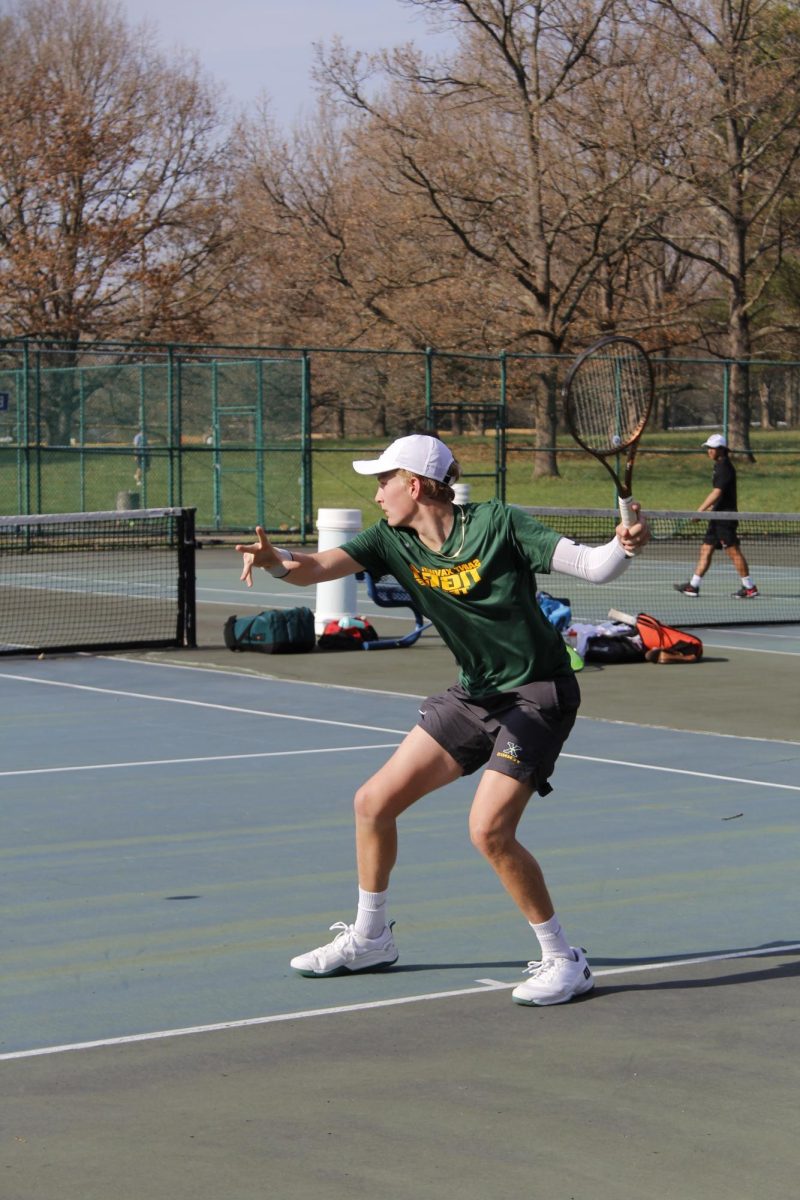
Derek Abrams, 15, a freshman at St. Xavier High School, first began tennis when he was 4 years old and currently plays on his high school team. He acknowledges the benefits of trying multiple sports.
“You get to see what you like the best,” Abrams said. “And whatever you like the best, I say just chase that one.”
Abrams tried basketball in third grade, but found he didn’t like it and was better at tennis. Now, he’s all in. In seventh and eighth grade, Abrams chose to do school online so he could have more time to train and travel for tournaments. He feels that beginning at an early age made him accustomed to the pressure, which helped him as the sport became more demanding.
“Starting younger, you can either be burnt out in the future, or you’re used to it, and you’re so much better doing it instead of starting late,” Abrams said.
At first, he only wanted to play at a high college level, but now he wants to go professional, too. Even though this might have been the same without basketball, playing another sport made him realize that tennis truly is his passion.
Another theory for why multiple sports are useful is that participating in more activities can prevent burnout in one of them.
For example, when Cargould was in middle school, she played basketball. She found that this helped take her mind off running at a time when her races were becoming more stressful.
“I had this other outlet,” Cargould said. “I could go to games, and I could go to practices and not really think about running.”
Under Pressure
Despite the risks involved with specialization, social pressures and competitive athletic programs drive parents and athletes to feel they must specialize to be successful.
In Abrams’ case, he chose to do online school because he saw his most successful competitors doing the same. From his view, it seemed as if all the top players at tournaments had already gone online, so he thought he should too.
Starck-Bean thinks these social factors are closely linked to parental pressure and competition. When children are young, they can’t decide for themselves to join a sport; it’s often the parents’ choice. While kids can demonstrate interest, it’s the guardians who pay for and commit them to lessons and training. Many parents push their kids to excel because they don’t want them to be at a disadvantage.
“I would 100% believe that this is all from parents,” Starck-Bean said. “Parents see what other kids are doing and they love their kids so much, they don’t want them to fall behind.”
In addition, parents and youth feel pressure due to the increasingly competitive environment of high school sports. According to a survey by Project Play, an organization focused on healthy youth sports habits, 53% of parents justified early specialization because their child wants to play in high school.
Many sports that cut athletes require students to be on varsity by senior year. This threat may compel some to specialize.
High school sports can significantly influence a child’s future as they often tie into college athletics. While rare, significant athletic scholarships can save top high school athletes thousands. These can reduce financial burdens on families, giving students an immense future advantage.
In addition to coaching, Starck-Bean is the recruiting coordinator at KIVA. She recognizes the pressure placed on youth to play in college.
“There’s hundreds of thousands of dollars riding on these kids,” Starck-Bean said. “I think the parents’ stress about money bleeds onto these kids.”
However, the concept of specialization can be appealing due to the potential benefits.
For skill-based sports like tennis or volleyball, extensive training helps refine and perfect specific techniques.
Codey thinks that focusing on volleyball helps her significantly. She’s among the nation’s best players and is a 10-time beach volleyball national champion, suggesting that early specialization can pay off.
Similar to Codey, Abrams has also been successful in tennis. He’s ranked as a top 200 player in the nation and is in the top two in Kentucky for his age. Since he began the sport so young, Abrams feels fortunate that his love for tennis hasn’t diminished.
“I say 4 was pretty young because I didn’t really know what I was doing,” Abrams said. “I think I just got a little lucky to keep playing.”
But even in highly competitive environments, Abrams ensures that he still has fun and avoids being pushed into commitments he isn’t passionate about. When scheduling lessons and tournaments, his parents ask his permission rather than forcing him into something.
This reduced pressure, along with a strong work ethic, explains how he’s maintained success despite the risks of specializing young.
Abrams’ internal drive to work hard is a quality that Bowling feels is a major factor in athletes’ performance. Bowling’s most successful athletes loved the sport and wanted to work at it, and that was more important than whether they specialized or not.
“If you’re preparing for the long game, where you’re going through high school, college and hopefully beyond, all of that motivation has to come from within, not from trying to impress somebody else,” Bowling said.
Without this driving desire to play a sport for the love of it, athletes face not only short-term risks but long-term implications.
According to a 2024 study by the American Academy of Pediatrics, 70% of youth athletes drop out of organized sports by age 13. Burnout, injuries or other commitments directly impact this dropout rate, increasing the chance that children’s impressions of sports and exercise will be negatively altered.
“I think exercise for the rest of us needs to serve as a lifelong activity that is good for both mental and physical well-being,” Bowling said. “Whereas I’ve seen so many kids overdo it in high school, end up hating that activity and never want to do it again for the rest of their lives.”
Exercise has an immense impact on mental and physical health, which directly correlates with longevity. Decreased motivation to exercise at a young age can shape habits and therefore lifelong outcomes.
According to a study published in the Annals of Medicine journal, those who participated in sports in high school had better mental health and physical activity outcomes at age 26.
Specialization can lead to high performance, as seen with Abrams, Codey and numerous professional athletes. However, elite youth often don’t remain successful through adulthood. Therefore, it’s up to young athletes and their families to decide whether the risks are ultimately worth it in the end.
“I think early specialization has been one of the most harmful things I’ve seen with kids and sports,” Bowling said. “I think we’re getting too far away from understanding what the true role of sports should be.”