JCPS is running out of money — quick. The district, larger than any other in Kentucky, has long been faltering under the massive weight of its nearly 100,000 students and 20,000 staff members. It’s no secret that this growing population, along with the resources they require, has left central office administrators scrambling to fund paychecks and programs. The district’s heavily publicized struggle to staff educator, transportation and managerial roles has led to a surplus of crowded classrooms, unserviced bus stops and cut courses.
Until recently, however, few were aware of just how far the problem had gone.
On Sept. 16, 2025, the JCPS Board of Education gathered to approve the budget for the following school year. Under the leadership of previous Superintendent Marty Pollio, who retired in July, the board had some understanding of the district’s financial troubles, but they were under the impression it was manageable. Now, newly instated Superintendent Brian Yearwood was going to tell them just how much money they were short: $188 million.
The math is simple — the district’s revenue is $1,609,751,118, while its spending is $1,798,213,875. But it’s what’s behind the numbers that has caused confusion.
In a letter published on JCPS’s website on Sept. 30, 2025, Yearwood said that the primary cause was previous overreliance on one-time funding sources, including budget surpluses and federal COVID-19 relief aid. With this money, the district introduced several technology enhancements, hired more school resource officers and mental health practitioners, offered incentive pay for bus drivers and dedicated more funding to racial equity programs, among many other school-based additions. Only later did they realize they didn’t actually have the money to have made the purchases.
“We hired extra psychologists and occupational therapists and physical therapists, and just a whole bunch of people that help support the needs of our students,” Linda Duncan, the JCPS Board of Education representative for District 5 said.
“We fully utilized that money to try and cover all the things that we thought we needed.”
Still, this raises another question: how did JCPS administrators fail to understand they were overspending?
An independent audit conducted in February provided an answer. Or, rather, several answers. The firm in charge of the examination provided an extensive list of main motivators behind the oversight, most having to do with a lack of structure within JCPS’s budgeting office and poor communication within leadership.
The report revealed that data analysis was not a primary factor in planning. Additionally, a financial forecasting model designed for district use wasn’t actually implemented and a committee dedicated to risk management didn’t adequately carry out its tasks. It also pointed out that Pollio had made several large spending decisions without consulting the JCPS Board of Education or the finances department.
“If you go back to old interviews with Pollio, he says there is a plan,” said Adi Schanie, a reporter at WDRB who’s been covering the crisis. “The district has said there was not.”
These findings paint an unflattering picture of JCPS’s central administration and demonstrate major failures in implementing effective internal organization and leadership structures. These oversights are disappointing, especially considering repeated patterns of irresponsibility and cutting corners on the part of the district over the past several decades.
However, as the clock ticks closer to the end of the school year, what matters most now is figuring out how to close the deficit, or at least minimize it.
On Jan. 14, Yearwood proposed an initial plan, involving cutting $142 million in spending, mainly by targeting central office positions and large-scale operational costs. Yearwood shared that he aimed to affect the student experience as little as possible and would avoid cutting teacher and other student-facing positions.
However, that didn’t mean the plan wouldn’t have a noticeable impact. At a board meeting on Jan. 20, during which Yearwood presented the proposal, the public’s dissatisfaction was clear.
The strongest backlash was from a group of several principals, who criticized the elimination of numerous academic instructional coach positions (AICs), as well as a coalition of mental health practitioners (MHPs), whose positions were also being put in jeopardy. They argued that they should’ve been more included considering the immense impact the plan would have on their schools. By the end of the meeting, the board voted to spare the MHPs from being cut, with the funding for AICs being eliminated instead.
“I love having support like that, but we can’t afford to fund them at the same level that we funded them before,” Duncan said, in reference to MHPs.
Other parts of the proposal also proved controversial. Among them were worries about the elimination of 61 elementary bookkeeper positions as well as an unspecified number of cuts to Exceptional Child Education (ECE) funding, which supports students with disabilities. Following board meetings in February and March, during which Yearwood offered more exact organization plans and the public was able to offer its opinions, the board voted against both recommendations. Representatives from both groups complained of the lack of communication and involvement on the part of district leaders.
Looming over the budgeting chaos is the ultimate decision- maker: the Kentucky General Assembly. The state legislature isn’t exactly known for its supportive attitude towards JCPS. In fact, it’s decreased the district’s per-pupil funding — known as Support Education Excellence in Kentucky (SEEK) funding — by 45% since 2008. During the most recent legislative session, lawmakers introduced bills aimed at splitting the district up and disempowering the board.
On April 1, the General Assembly sent a finalized two- year budget to the governor for approval. Although it included an overall increase in funding for the Kentucky Department of Education, it cut funding for several specific programs. These cuts included $7 million less for school-based mental health service providers, one of the roles targeted by JCPS, and $18 million less for school resource officers, a category which the district had overspent on. There are correlative effects between these changes and the district’s financial struggles, but JCPS hasn’t pointed to the state budget as a reason for the deficit.
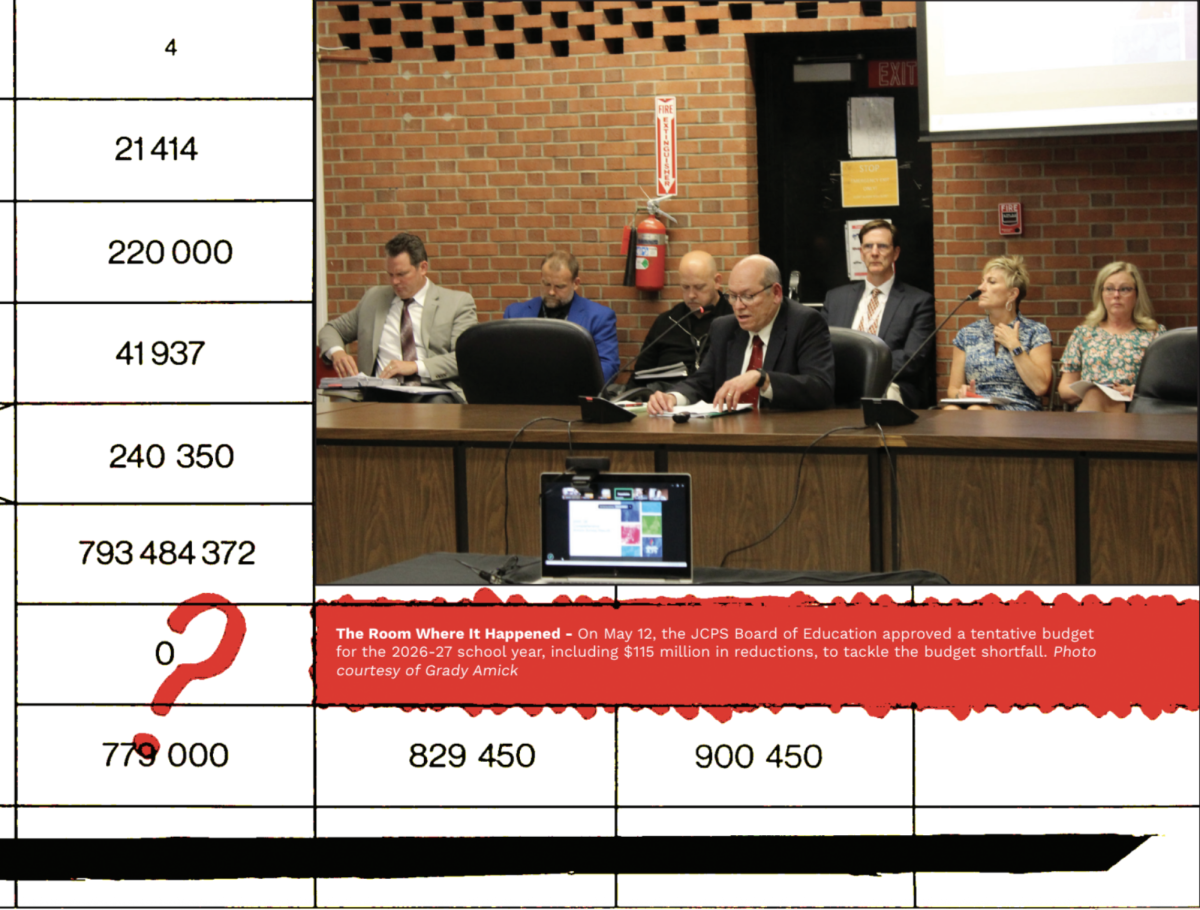
On May 12, the district approved a tentative budget for next school year with $115 million in cuts, short of the district’s goal of $132 million.
But the future remains unclear: a deficit of around $82 million will continue into next school year, and the district is not currently projected to reach a balanced budget until 2031.
What can be said for sure is that this shouldn’t have happened. JCPS certainly carries part of the blame, but so does our government, both at a state and federal level. Kentucky’s state constitution requires that students be provided with a quality public education. When you consistently neglect the system designed to carry out this task — failing to designate adequate funds for and villainizing it — it’s no wonder that it will begin to crumble.
Cutting Corners
When Abigail Smith, 16, a sophomore at Atherton High School, received an email telling her she had been accepted into Craft Academy, a competitive and rigorous program which allows high schoolers to spend their junior and senior years at Morehead State University, she was elated.
“I’ve been wanting to go there since I was in fifth grade,” Smith said. “It’s a great opportunity.”
Craft covers nearly every expense for accepted students: rooming, food, tuition — everything except their books, which can cost an average of $1,200 a year. Typically, Atherton would’ve covered this expense, but due to a shortage of funds, the school informed Smith it will no longer be able to do so.
It is important to note that the funding issue in this case is not a direct consequence of the district’s broader budget shortfall, but also of the 2026 House Bill 500, which changed SEEK funding allocations for students enrolled in state academy programs. As a result, JCPS no longer receives SEEK funding for students attending academies such as Gatton or Craft Academy.
Smith, who comes from a low-income family, said she would have to find another job over the summer in order to pay the cost.
“I am already pretty anxious,” she said. “I’m going to be the first person in my family to complete college and I’m so excited, but I don’t want this fear.”
Smith’s worry is fueled in part by a lack of information. She said she knows about the district’s overall funding crisis, but has found it difficult to keep up with the frequent changes and complex financials. Earlier this year, she joined a JCPS parents’ group on Facebook to see what people were saying.
“There’s a lot of people switching to private schools or even moving out of the district,” Smith said.
She expressed frustration with the district for not doing more to inform families of potential cuts, especially because many may not be able to keep up with news reports on the issue. For now, however, she’s mainly focused on making sure she’ll be able to attend Craft next year.
“The cost should not be the thing that holds me back,” Smith said.
Similar situations are playing out across JCPS, due both to proposed budget cuts from the district and funding reductions from the state.
At Ballard High School, students recently received handouts explaining that the finalized state budget did not include adequate funding to continue providing course scholarships for students taking AP and dual credit classes. In years past, the school would cover most of the fees associated with the classes. Now, however, students will have to pay full price for AP courses, and the scholarships available for dual credit classes have been reduced.
“The full fee for the AP class is $125. So, times three, I’m going to pay $375,” said Luzianna Nana, 15, a sophomore at Ballard. “It’s $300 to take a dual credit course now, and it was free before.”
Nana said that although she’d still be able to take the courses next year, she knows several students who are now working with counselors to drop out of the classes and reorganize their schedules.
“They have to choose now,” Nana said. “A 300, 400, 500 something deposit just to take a higher level class, or lose their shot on that form of education, which already we know gets them ahead further in college applications.”
She agrees with Smith that following the budget crisis has been frustrating, and she wishes JCPS would do more to explain the situation to its students and teachers. Both students feel that the problem demonstrates the district’s overall responsibility.
“Somebody had to have gotten lazy with our finances at one point,” Smith said. “It takes a lot of time to get to a number like that, and it’s just frustrating and confusing.”
Other students are in for even more severe impacts as a result of cuts.
In January, the board voted to close two schools, Zachary Taylor and King Elementaries. Combined, they enroll around 600 students, who will now be placed at other schools for the 2026-27 academic year. Following the vote, parents gathered to protest the decision.
Along with schools, several student-serving programs and initiatives are also being eliminated or significantly reduced. For example, the district’s partnership with the Transit Authority of River City (TARC), which helped expand access to public transportation for students, is being dissolved, along with the widely utilized Summer Success League program and Evolve502 scholarship fund.
Additionally, roughly $18 million is being removed from the district’s Needs Index Fund, which awards schools differing levels of financial support based on several demographic factors.
The funding is intended to be used by schools with high numbers of students living in poverty, so that they may invest in extra support and resources. It is largely used to pay school staff. For instance, Valley High School, where two-thirds of students qualify as being economically disadvantaged, is having a huge portion of additional funding removed.
“They went from getting $800,000 from that equity fund, based on their needs index, down to $200,000,” said Duncan.
Miscalculations
The district’s failure to be fully transparent became even more concerning when reports revealed the numbers they were giving to the public didn’t correctly add up.
At a board meeting in January, Yearwood promised to eliminate 300 central office positions, equating to around $44 million in savings. However, organizational charts provided at the meeting show something entirely different, with the staffing reductions saving only $31 million.
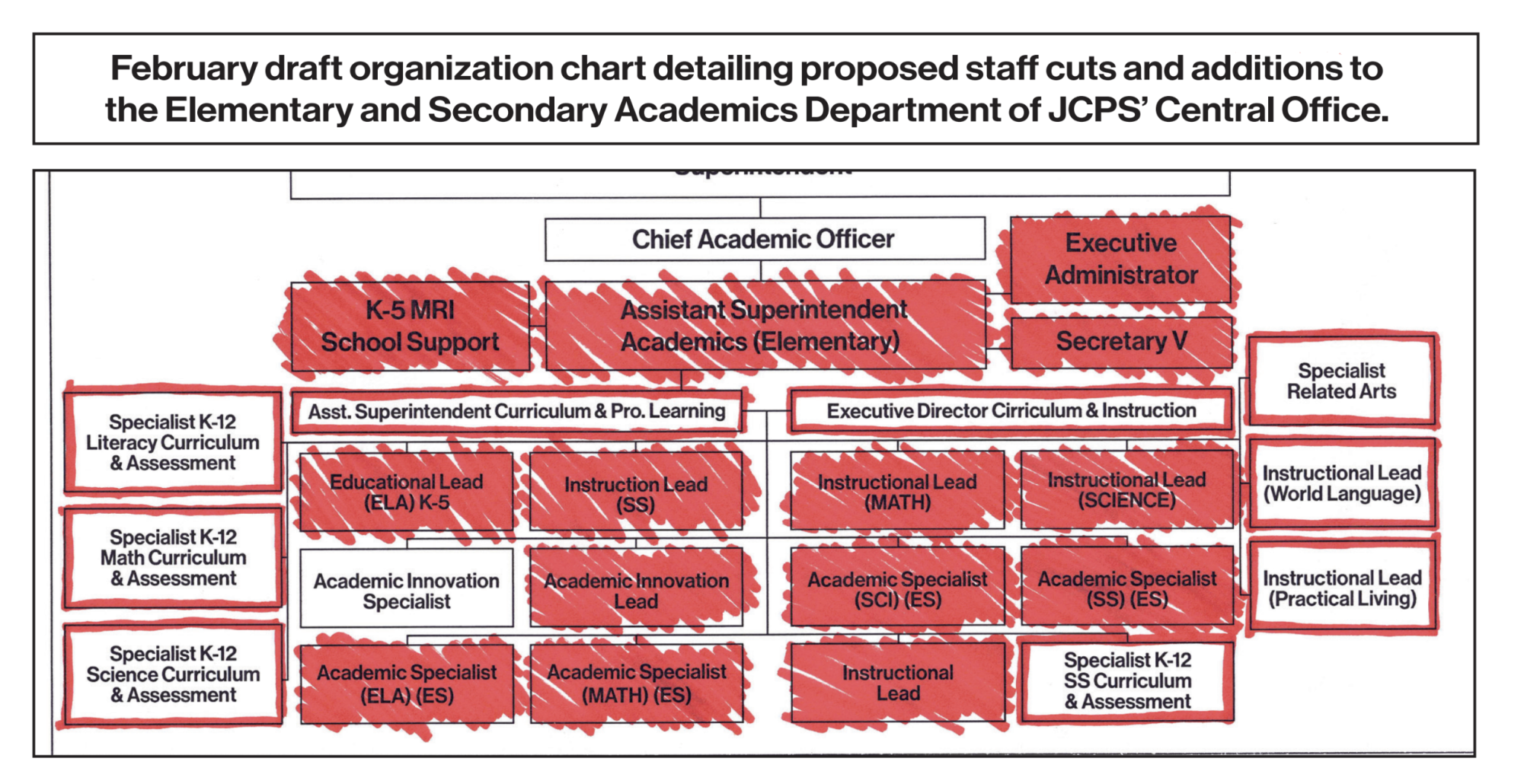
At the next board meeting in February, district leaders said the remaining $13 million would result from cuts to the ECE division. However, yet again, when they released their finalized numbers, they had only reached a fraction of that goal.
Central office cuts have proved especially controversial due to their misleading nature. Despite the name, many employees under this umbrella actually cycle between a small group of schools, meaning they do work in student-facing roles. In terms of cuts to sections other than the central office, things seem more on track. Still, though, numbers continue to fluctuate and conflict.
“Part of that is typical of a budget process,” Schanie said. “They’ve got a lot of numbers, and things change and students change.”
However, stakeholders feel as though they should be more informed, especially when the decisions being made are directly affecting them. Staff in central office roles feel especially left out of the conversation.
“If you’re a 10 or 15 or 20 year veteran of JCPS, you’re in a middle management position, all these changes are happening around you,” said Sam Corbett, a former member of the JCPS Board of Education. “You’re not sure if you’re going to have a job or if your friends that work with you are going to have a job. I mean, that’s pretty unsettling.”
…
As I write this in early May, the situation is still changing. On May 6, the district announced that they would consider taking out a line of credit — essentially a revolving loan — to cover teacher salaries next year. Then, on May 12, the district approved the tentative budget ahead of the May 30 deadline, raising concerns in the community. However, the future financial security of the district remains uncertain. It’s difficult to point fingers in a situation like this one, especially when there’s no clear antagonist. “The superintendent, when he stepped into that role, July 1 — and they hired him in April — he had some sense that there was some budget issue, but he was not aware of the depth of the problem,” said Corbett. And, although the district has failed to provide easy access to information, that’s mostly due to the fact that they haven’t truly settled on a solution. Without a clear plan, what would they tell us?
At this point, all we can do is advocate for ourselves. For the protection of our schools and programs. For the protection of our teachers. And, going forward, for more financial responsibility in our leadership. We’re watching bad decision-making play out in front of our eyes, and we should refuse to let it happen again.