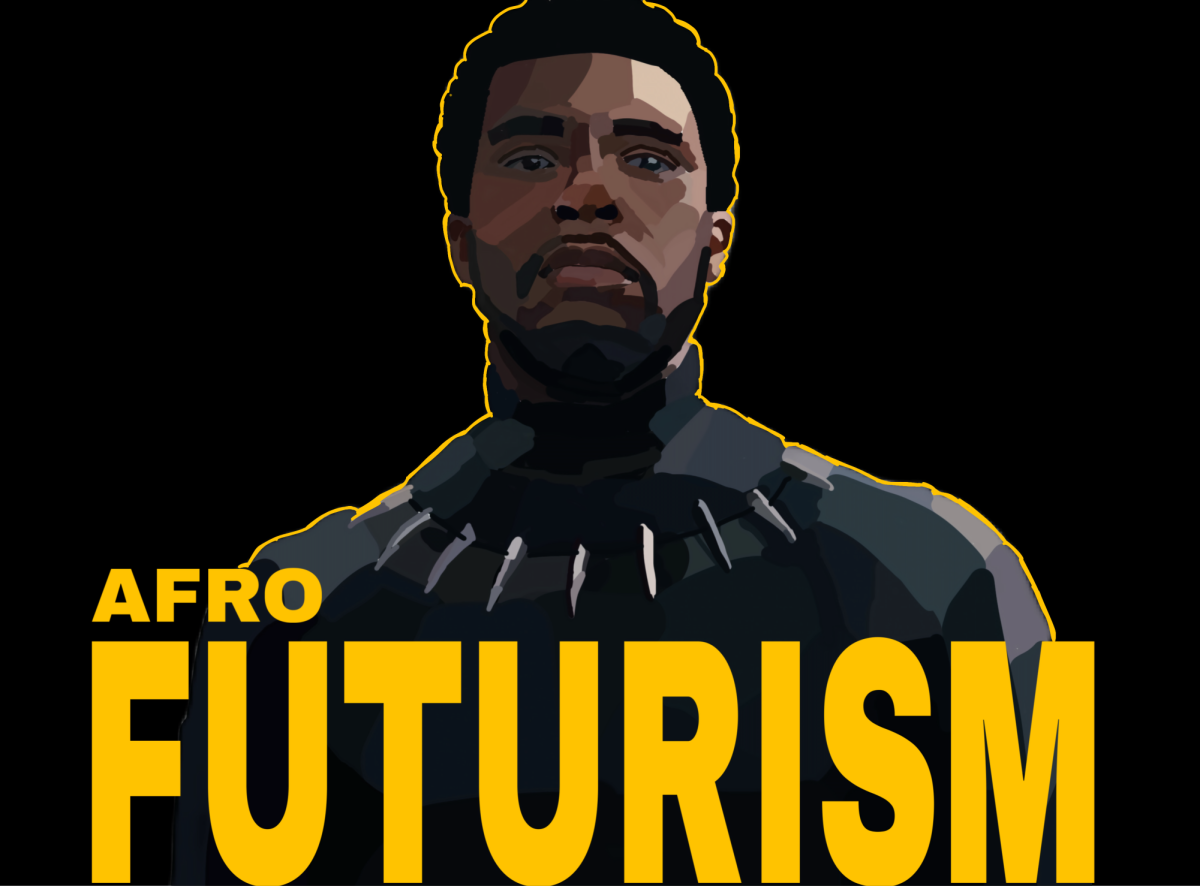
As we explore the vast cultural history of Black people, one of the most famous cultural developments is Afro-futurism, which has gained traction with works like the Black Panther franchise, Get Out, and Nope.
Afro-futurism is described as “an aesthetic and literary movement that focuses on the intersection of Black history, culture, science fiction, and technology.” The term was created by white journalist Mark Dery in 1994 in an interview for the “Black to the Future” article. Afro-futurism combines elements of science fiction that connect with Black livelihood, struggle, and culture.
Many works in this field depict Black people in ways that, for the longest time in media, were only filled by dominantly white people. An example of this is the famous Black Panther movie, which highlighted Black Life, specifically Afro-Black people.
Black Panther follows the story of the main character, T’Challa, who returns to a highly advanced African nation called “Wakanda” to become the new king after his father’s passing. Now taking on the role as king, he consumes an Herb that rulers of Wakanda have been fed for generations, giving him strength and agility. Later, T’Challa is challenged for his role as king by Erik Killmonger, a former prince who was sent to America and is later revealed to be T’Challa’s long-lost cousin.
Erik and T’Challa end up going head-to-head in a life-or-death ritual battle at Warrior Falls for the throne. When T’Challa ends up assumed to be dead, Erik Killmonger takes over Wakanda, acting as a monarch wanting to use the contents of Vibranium to enact a revolution for oppressed people across the world. T’Challa ends up being alive and goes back to fight Erik for the throne. engaging in a civil battle amongst the now politically divided Wakanda. T’Challa ends up winning, and suggests allowing Erik to live- but Erik denies, saying he would rather die than become a prisoner and requests his body to be buried at sea, as a commemoration to his ancestors who jumped from slave-ships to achieve freedom. T’Challa does as Erik wishes and has to decide if he wants Wakanda to stop being isolated.
Black Panther includes themes found in Afro-futurist work, including elements of the African Diaspora and racial/cultural identity. In the movie, we see the developments of advanced technology, women in major leadership roles, African fashion, and the advocacy for the betterment of black people. These are all prime topics explored in the genre of Afro-futurism, and continue to be adapted in the genre- including the 2022 “Black Panther: Wakanda Forever.”
Afro-futurism is a genre that uplifts the Black community through means of film, literature, and art. The genre continues to expand, shedding Black people in a better light, after decades of racially stereotypical movies and racist eras like Jim Crow. As we continue into the last week of black history month, let’s reflect on how works like Afro-futurism have positively affected the Black community