This article reflects the views of Isabella Shory alone and does not represent the opinions of On The Record magazine or duPont Manual High School.
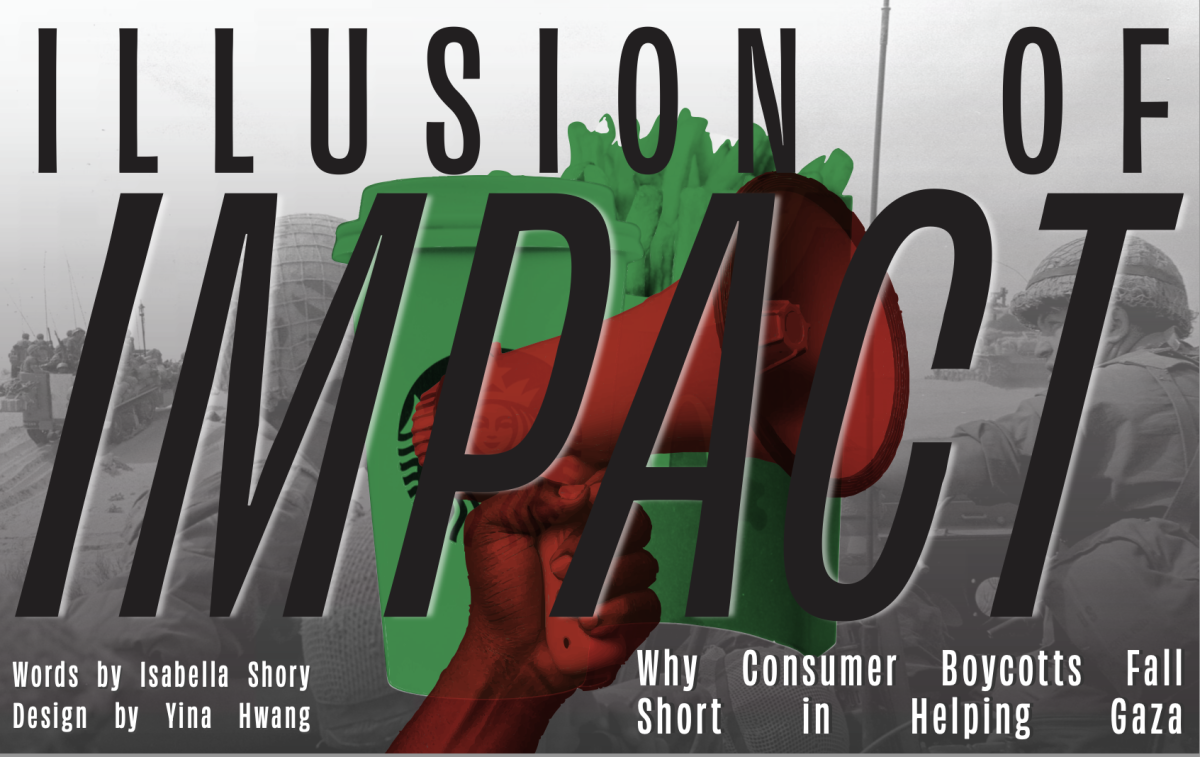
In December, as the air cooled and the holiday season strengthened its grip on America, many flocked to their nearest Starbucks for festive drinks and viral bear-shaped cups. Yet, for some consumers, the popular chain is sworn off entirely due to its perceived stance on the Israel-Hamas conflict. This boycott began in October 2023 and remains ongoing. As images of the chain’s trademark mermaid logo, doctored with dripping blood, fill their social media feeds, these well-intentioned protesters truly believe that they are making a difference. However, the war is still ongoing despite peace attempts, children are still dying and Americans forgoing a Peppermint Mocha doesn’t do anything to help.
According to the Gaza Health Ministry on Nov. 29, 2025, more than 70,000 Palestinians have been killed in Gaza since the start of the Israel-Hamas war, and 77% of the population is facing crisis-level hunger or worse. There is a current humanitarian crisis in Gaza that must be addressed, and it isn’t wrong to want to take action. It’s passionate activism like this that is needed to turn the tide on public opinion. However, we ought to be directing our energy not toward boycotts with negligible impact, but toward solutions that will bring about real change.
Consumer boycotts are a main pillar of the Boycott, Divestment and Sanctions (BDS) movement, which aims to “end international support for Israel’s oppression of Palestinians and pressure Israel to comply with international law.” The BDS movement often faces criticism for allegations of antisemitism.
However, even if you choose to support this movement, viral boycotts often don’t align with its goals. BDS’s website targets a small, specific number of companies to maximize impact. It advises against long lists of companies that have unreliable connections to Israel, though these are the sort that have become viral online. BDS’s official list of consumer boycott targets, posted in June 2024, primarily consists of corporations to which Americans don’t often contribute money. These include European companies like Carrefour, as well as those that offer infrequent purchases, such as RE/MAX, Dell and Intel Corporation.
But when a crisis like the conflict in Gaza seems so distant and complex, many sympathizers feel powerless, grasping for any action that will seem like a worthy contribution. When boycotts of recognizable brands like Starbucks and McDonald’s surfaced online, many of these idealists latched onto this movement.
However, many protesters aren’t fully aware of the background behind these boycotts.
According to Google Trends data for the United States, the search term “Starbucks boycott” has been used significantly more frequently than terms related to other boycotts of Palestine, far surpassing those of companies that BDS has targeted.
The Starbucks boycott began when the company sued one of its unions for expressing solidarity with Palestine on social media. Though neither Starbucks nor its former CEO, Howard Schultz, provides any financial support to Israel, this did not prevent false rumors from spreading online, further contributing to boycott fervor.
“Rumors that Starbucks or Howard provides financial support to the Israeli government and/or the Israeli Army are unequivocally false. Starbucks is a publicly held company and, as such, is required to disclose any corporate giving each year through a proxy statement,” said the Starbucks corporation in a 2023 statement.
While the movement against the coffee giant went viral on social media, that doesn’t automatically provide it any merit. The Starbucks corporation has no credible ties to the Israeli government or military. Skipping a caramel macchiato has not saved any Palestinian’s life.
The McDonald’s boycott has also gained significant traction on social media, again likely due to its proximity to American consumers.
This movement began following McDonald’s Israel’s decision to provide free meals to Israeli soldiers. However, the decision to boycott based on this move lacks important context. McDonald’s uses a franchise model, with local franchises acting independently. This means that an American’s decision to forgo a Big Mac has no impact on the Israeli franchise’s decision-making, and the boycott instead hurts local franchises. For example, in Muslim-majority countries, where the boycotts have strongly taken hold, many McDonald’s franchises have pledged support for Palestine and donated to support humanitarian aid. Yet these are the restaurants experiencing the most significant decline in consumer support due to boycotts, while the Israeli franchises remain largely unscathed.
While these are just two examples of companies with ambiguous ties to Israel, consumer boycotts as a whole distract well-intentioned Americans from the main funder of Israel’s military: the United States. According to the Stockholm International Peace Research Institute, the U.S. has supplied 69% of Israel’s arms imports from 2019 through 2023. The U.S. government has a drastically larger role in this war than any boycotted corporation.
Boycotts aren’t completely ineffective; they can raise awareness on an issue and encourage positive momentum. But to meaningfully support the people of Gaza, Americans should make it clear to their representatives that unconditional military support for Israel deserves serious public scrutiny. Criticism of Israeli government policy is not criticism of Jewish people, nor does it diminish the very real fear of antisemitism that many Jewish communities face. We should use our vote to elect officials who will ensure peace for all parties, rather than a president who has already proven blind support for Israel and a willingness to undermine Palestinian autonomy.
Additionally, while Israel heavily restricts aid in Gaza, organizations like Doctors Without Borders and World Central Kitchen work tirelessly to provide much-needed relief in affected areas. Donating to these organizations is the most effective way to use your dollar to make a real difference.
Though the magnitude of this crisis is often overwhelming, Americans should strive to use their dollar and voice in ways that truly help Palestinians.