

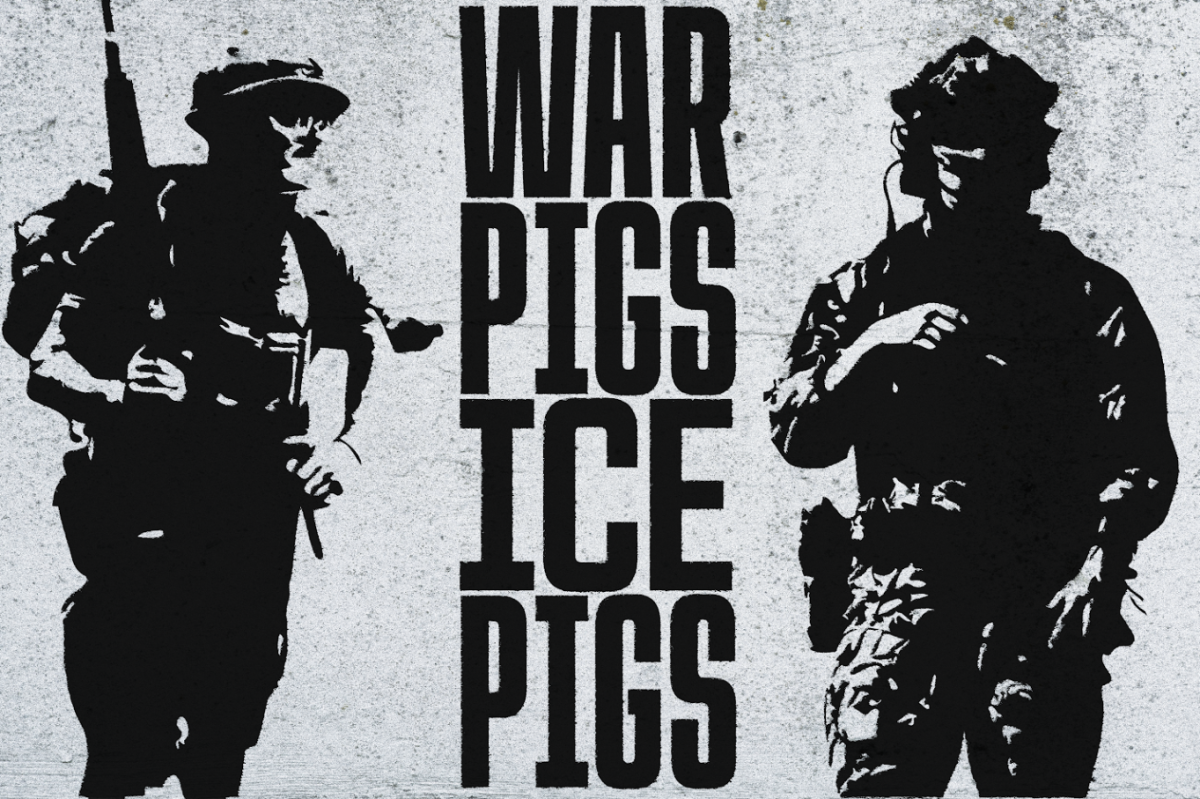
This article reflects the views of Zoe Huguley alone and does not represent the opinions of On The Record magazine or duPont Manual High School. Readers may find this piece best experienced while listening to “War Pigs” by Black Sabbath.
“Generals gathered in their masses, just like witches at black masses”. The opening lines of “War Pigs” by Black Sabbath begin with this striking statement. I was driving home from the gym the other day, half scrolling on my phone on Instagram stories at red lights, half driving, with the song playing in the background of my ride.
As I thumbed through the stories, I came across selfies, sororities’ philanthropic work, requests for shoutouts, anti-ICE reshares, and more.
It’s strange how easily it all blends. One story is a fundraiser, the next is a deportation infographic, then someone’s dinner, and then a selfie. Everything gets the same amount of space. The same thumb movement and glance. Tragedy feels flattened when it’s sandwiched between things that don’t ask anything of you.
After I got honked at due to my haphazard driving, I set my phone down and let the music take the wheel for the rest of the ride. War Pigs is a long song, nearly eight minutes in length, and it guided me for the rest of my drive. As I drove, I began to wonder when the song was released. Although I’m a fan of the band, Black Sabbath is nearly archaic in my mind, but the lyrics seem to be true. In the midst of the Epstein files, ICE agents ripping families apart limb by limb and the seeming apathy from everyone surrounding me, if War Pigs were released today with a catchy disco beat behind it, it’d be topping the charts for its honesty.
So, has anything changed in America since the song was released on September 18, 1970? Nearly 56 years ago?
When War Pigs came out in 1970, America was deep in the Vietnam War. Generals and politicians were making decisions that cost thousands of lives, and people back home felt both powerless and outraged. Black Sabbath didn’t hold back; they painted these leaders as profiteers, as people who watch from the blinds of their office windows, peeking out at their destruction while others suffer. Listening to it now, the moral distances the lyrics call out are the same kind of abuse. This is not to say that the soldiers fighting the Vietnam War were even a percentage as evil as an ICE agent. Those were misguided teens and beyond sent to a foreign land, told an empty promise that they were protecting their country. I simply do not care how much money an ICE agent could be making; they are pigs.
One line that kept circling in my head throughout my drive, and ever since I’ve been relistening to the song, is “Politicians hide themselves away.” It’s simple, and almost lazy, but the bluntness is what makes it so laughably true. They don’t have to be present; the line doesn’t have to be flashy; they don’t have to see anything. The damage happens somewhere else, to someone else, and that distance is what makes it possible. You can convince yourself of anything when you don’t have to watch it happen.
Later in the song, Sabbath talks about “evil minds that plot destruction,” and that line feels uncomfortable because it removes the excuse of ignorance. These outcomes aren’t the backfiring of an ignorant president that can be leaned on by his own stupidity. The suffering isn’t accidental PTSD firing of Vietnam soldiers nor, modernly, the ICE agents nor the poorly worded directions from their employers. Someone ran the numbers, signed the paper and went back to their palace, mansion or other lavish form of housing. That part hasn’t changed.
Back then, it was justified as war. Now it’s justified as policy. The language is calmer and more professional with the same logic. If you promise the people that it’s necessary enough times, eventually they will stop knocking on your door asking about their neighbor and instead shelter themselves inside, afraid of their own fate.
Because when I look and listen around me, it feels the same, but the battle is being played on civil turf. The “generals” might not be sending soldiers overseas anymore, but there are systems in place today—like ICE—that operate on a similar principle. Decisions get made by people far removed from the consequences. There are five-year-old children picked up off the street in kidnapper vans that the government has sent. Mothers and fathers walk to work one day, and their infant children never see them again. Beautiful girls and athletic boys, and people with no standout features at all, are put into cages. Families are discarded, people are lucky to get a news headline or an Instagram infographic made from their name and tragedy, and the public scrolls past it, barely registering the human cost.
And the way leaders justify it is familiar too. In the 70s, the basis was patriotism and the “greater good” of war. Today it’s justified as the natural consequence of law, order and national security. The rhetoric speaks of a clean, moral and almost comforting United States of America, where a figurative wall safeguards the people. You look at stories of raids, deportations and families being ripped apart, and it’s hard not to feel like putting on our blinders. Just focus on what’s in front of you. What is your sorority doing next? How can you grow your Instagram following? If you repost that infographic, then you are certain to achieve the moral high ground. I am guilty of this as well, because what else are you supposed to do? Those who speak out have suffered the consequences. They’ve been used as a bloody example.
And I don’t think most people are heartless. I think they’re tired, scared and aware of what happens when you speak too loudly. In the Vietnam era, thousands of young men faced the draft and protest—people like the Camden 28, who broke into a draft board to make a statement against the war and then stood trial for it, becoming symbols of resistance and the cost of speaking out. Others, like Father Daniel Berrigan and his brother Philip, burned draft records and ended up in prison for their activism. Every choice against the system is a gamble at being used as warnings and examples to others about how far dissent could go.
Today, there are similar examples people point to under ICE enforcement. Last year, immigration rights advocate Jeanette Vizguerra was detained by ICE after long public advocacy work, and that detention sparked protests and media attention. More recently, the case of five-year-old Liam Conejo Ramos and his father being detained and then released after national attention underscored how families, specifically children, can become focal points in the immigration debate. These cases get talked about, shared online and turned into warnings. To the activists, to the families, to anyone who might speak too loudly. That’s part of why a lot of us repost, nod along and move on. I do it too. I’m not sure what the alternative is supposed to be.
That’s why War Pigs still works. Whether it was Vietnam or ICE, the pattern is the same: people in power decide from far away, and everyone not suffering lives with it or literally dies trying. Listening to it in 2026 doesn’t feel like looking back. It feels like realizing we’ve been here the whole time.
Sources: https://apnews.com/article/immigration-sanctuary-jeanette-vizguerra-denver-detained-1351ff26c84fbee44fd2373b54f563f3
https://www.cnn.com/2026/01/31/us/liam-ramos-judge-release-ice-detention
Link to support anti-ICE organizations: https://raicestexas.org/
Link to support veterans: https://www.backpacksforlife.org/?gad_source=1&gad_campaignid=22276709001&gbraid=0AAAAADNSl4m9wkwwkJB2FvwfFHyiRAdE8&gclid=Cj0KCQiA-YvMBhDtARIsAHZuUzKCbTetogL_fKxETzyRyIUQTSr9F7d3TQQ9oGktM3oppd1qohVd6NcaApy7EALw_wcB













Dea • Feb 5, 2026 at 11:47 pm
This is SO good. Wow zoe