Picture a quiet Sunday morning. The scene outside your window is serene — the first rays of sunlight cresting the sky, the dew brightening the grass blades — until the gentle whirring of a bicycle and a thud breaks the silence. Rubbing sleep from your eyes, you pull open the front door and grasp the rolled-up paper before returning inside. Now at your dining room table, a hot cup of coffee sits in one hand and your local newspaper rests in the other. In just one read, the carefully curated stories catch you up on the news, all in one place.
This was a typical routine for my parents and grandparents in their youth. However, in today’s digital world, it has become unrecognizable to people my age. Rather than relying on a single, trusted place for news, many youth now look to a source more close at hand: social media.
Some older generations might not recognize how news looks to teens today. With a chaotic mix of clickbait titles and short snippets, checking the news isn’t intentional anymore. Now, people see it whenever they open their phone.
According to a 2024 study by the News Literacy Project, 83% of teens aged 13 to 18 use social media to stay updated on current events.
Through these algorithms, users can curate feeds that reflect their interests and beliefs, but with the average time youth spend on social media reaching almost five hours per day, it can be difficult to control what content comes next.
In the span of seconds, users are exposed to a wide range of perspectives and opinions from all over the world. With no real requirements to release factual statements, much of the information consumed online is incorrect or misleading, causing experts to raise concerns about the media literacy of today’s teens.
In a 2025 study from the Journal of Personality and Individual Differences, researchers reported that Gen Z is the most vulnerable to misinformation across all age groups who participated, linking the lower quality of social media based news to this rising disparity.
The unreliability of these platforms contributes to both the spread of misinformation and political polarization, leaving uncertainty about how youth can effectively navigate this changing landscape.
Christina Veiga, the senior director of media relations for the News Literacy Project, explained that, although there are reputable journalists and publications on social media platforms, many teens don’t get their news from them. Instead, they often follow miscellaneous influencers or accounts for updates.
“Forty-five percent of teens told us that they are not following any reporters or news organizations on social media,” Veiga said. “A lot of teens are just not getting the news and information served up for them.”
However, Aaccording to the Pew Research Center, while 37% of adults under 30 get their updates from an influencer, 77% of them have no journalistic experience or ties to an official publication.
Of the content creators in the study, 27% identified as Republican, conservative or pro-Donald Trump, whereas 21% identified as Democratic, liberal or pro-Kamala Harris.
Caroline Keith, 16, a junior at Walden High School, said she found that recent news on social media leaned toward the Republican Party.
“I think because of the suppression of journalism right now, it’s hard to find things that are in the middle, nonpartisan,” Keith said. “I try and intake a lot of left journalism or even nonpartisan, but it’s kind of hard to find.”
Swaying the Votes
Since youth are increasingly using social media platforms for news, politicians are thinking logistically about targeting specific demographics.
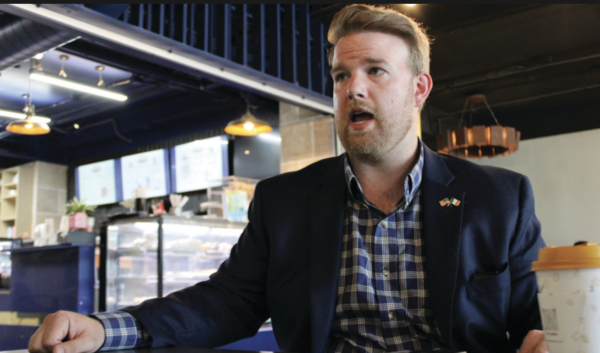
campaign strategy, specifically his tactics on social media on October 14th at Bayt Al Mocha. “In my view, social media is meant to uplift
and amplify some of the things that you’re doing, and it’s meant to highlight a lot of the groups that you’re going to be serving,” Morley
states. (Photos by Sadie Eichenberger)
Max Morley, a candidate running for state representative in Kentucky’s 30th district, said the way he campaigns differs depending on his audience.
“If I had a more traditional makeup of voters in a district, or if for some reason it’s skewed younger, I’m going to really hit social media with ads,” Morley said. “I’m going to hit ads on places where young people are, like TikTok.”
Although Morley does not have a large social media presence due to his district’s older population, he recognizes the benefits that social media campaigning can have.
“In my view, social media is meant to uplift and amplify some of the things that you’re doing,” Morley said. “It’s meant to highlight a lot of the groups that you’re going to be serving.”
Still, these sites do come with a new set of risks. Given its ability to connect people quickly, social media can provide a ground for many heated discussions. While some candidates may engage in these debates over social media, Morley takes a different approach.
“I think it’s unbecoming of an elected rep to have a back and forth,” Morley said. “I do avoid that, just to maintain a level of decorum on my page, because I do consider those pages as spaces for people to get information about me, and I don’t want to make that a toxic place.”
Historically, however, it is difficult to compete with other politicians without leaning more on new mediums for communication.
In previous decades, political figures relied on televised ads, debates and in-person interactions, but now, with the rising prominence of social media, candidates kickstart their campaigns through digital presence.
A UCLA Newsroom study found that Gen Z and millennials who frequently consumed digital media were 18% more likely to plan to vote for Kamala Harris in the 2024 presidential election, compared to those who reported not using digital media at all.
The well-known TikTok account, @kamalahq, may have had a significant influence.
Harris’ account took off during her campaign, and as of August 2024, her 65 posts gained a total of 385 million views — an average of 6 million views per post. However, Harris was not the first presidential candidate to use various social media platforms to cater to a younger generation of voters.
Former President Barack Obama is also known for connecting youth through social media. His use of newer technological advancements is often compared to Franklin D. Roosevelt and John F. Kennedy’s use of radio and television to reach people across the country.
While social media has greatly increased the reach for politicians and their campaigns, the lines between actual news and political messaging can become blurred.
It’s hard to look at social media and not see updates about international affairs, celebrity happenings or the latest political events, which can be the most polarizing of all.
Even content that may seem innocuous can have political undertones. Viral videos such as former President Joe Biden stumbling up jet stairs or President Donald Trump dancing can affect people’s views just as much as political news.
Recent political shifts can be attributed to social media. For example, young men have swung sharply to the right. In 2020, 56% of men aged 18 to 29 voted for Biden, while in 2024, the same percentage voted for Trump.
This shift is connected to the development of the “manosphere,” a network of social media pages and online forums promoting combative masculinity and traditional gender roles. Influencers in this pipeline, like Andrew Tate and Jordan Peterson, have aided in right-leaning political outcomes.
The design of social media platforms spread this extreme rhetoric. Veiga reports that algorithms play a crucial role in contributing to someone’s confirmation bias, or the idea that people might interpret information in a way that aligns with their preexisting beliefs. Especially when it comes to politics, teens getting news solely from social media may only be hearing an echo chamber that encourages further polarization.
“We don’t hear about — learn about — other points of views or other experiences that people are having,” Veiga said. “Ultimately, the social media platforms want to keep us engaged, right? Our attention is what they’re after, and so they’ll keep serving up things that they think will keep you scrolling.”
Asha Valentine, 16, a junior at the J. Graham Brown School, has observed this phenomenon, and said that she found her feed to be leaning left, given that she often interacts with posts falling into that category.
“I know I lean a certain way, so my media does too,” Valentine said.
Calls to action are another popular form of online political messaging. One recent event that flooded social media platforms was the Oct. 18 “No Kings” protest, a movement that took place around the country in objection to Trump’s actions during his presidency.
With today’s widespread accessibility to events through various social media platforms, gathering for protests has become much easier.
Valentine, for example, heard about the “No Kings” protest through social media.
She said that, in the aftermath of the protest, some publications and politicians attempted to portray the movement in a negative light.
“A lot of what I saw from protests around many different movements was a lot of media trying to sway it,” Valentine said. “I saw that with the ‘No Kings’ protest, too, even after I attended. There were certain politicians and certain people in the media trying to make it seem violent and horrible and like we were doing terrible things, but that’s just not true.”
Valentine said that she heard about the protest through Instagram because she’s very politically active online. Although she often finds the amount of news on social media overwhelming, she urges people to be aware of what’s going on in the world.
“Read the news,” Valentine said. “Don’t stay uninformed. Stay political.”
Slowing Down, Logging Off
In a sea of posts and reels, it can feel impossible to discern fact from fiction.
However, Veiga has guidance to prevent negative impacts of social media misinformation. She advises teens to actively seek out different perspectives on a story, rather than passively receive news while scrolling through their feed.
“You need to be intentional about seeking out the news and information, because like I said, these algorithms might not serve it up to you,” Veiga said. “Especially when you’re not following other news organizations.”
Although the news landscape on social media can seem complicated, learning to navigate it doesn’t have to be, according to Veiga.
“The good news is that you can learn how to spot falsehoods just by learning some simple news literacy skills, like checking your source, doing a quick search to see if other people are reporting the same claim,” Veiga said.
She also says that the best thing to do when looking at news-related social media content is to think about the purpose and what the audience might get out of it. Asking a few simple questions can go a long way.
“What am I looking at? What is the purpose of this information? Is it actually news?” Veiga said. “Or is it something that just looks like news, but is really trying to convince me of something?”
Veiga believes that, due to the potential negative impacts of political messaging on social media, increasing news and media literacy in teens is crucial to help them navigate the new political and online world.
“The best thing that students can learn how to do and that teachers can help students learn how to do is just to slow down,” Veiga said. “It sounds simple, but it’s actually really hard to slow down and pause to think and analyze your own emotions when scrolling through these platforms.”
…
Now, imagine how you get your news. What used to be the paperboy dropping off the daily newspaper is now thousands of voices condensed into one social media feed.
So next time you start scrolling, take a moment to reflect on how this constant barrage of information may affect you, your views and, ultimately, your actions as a voter.